SodaMelt Official Website › Blog › Aloe Leaf Is Not Aloe Gel
Aloe Leaf Is Not Aloe Gel: Three Layers In One Cut
Slice an aloe leaf across and you get three materials, not one. The rind, a bitter yellow latex just beneath it, and the clear gel at the centre. They are sold for different purposes, studied in different literatures, and a panel that says only “leaf” has not told you which one is in the capsule.
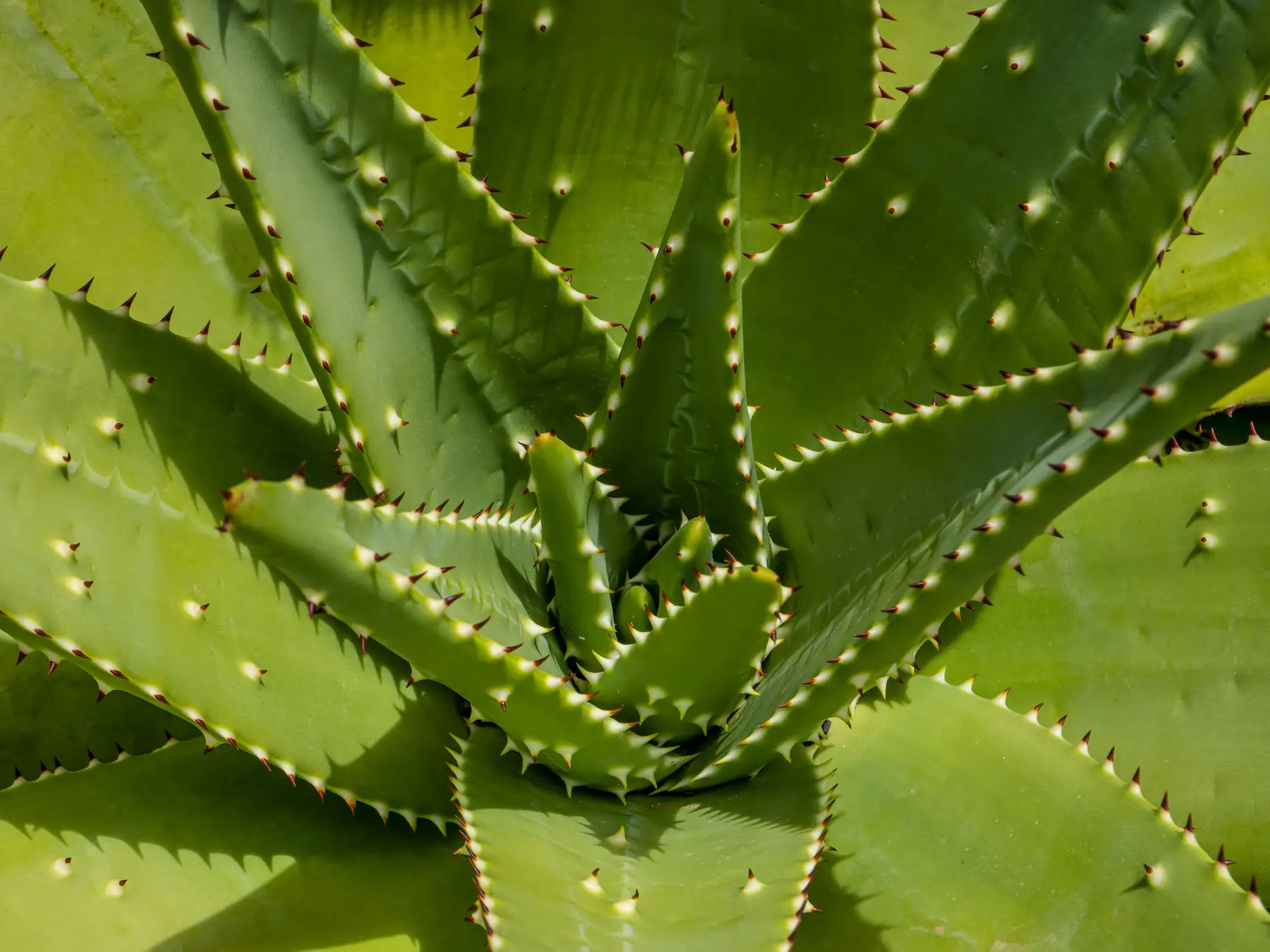
- A cut aloe leaf yields three distinct materials: rind, latex and inner gel.
- The latex carries the anthranoids and is the reason aloe appears on laxative products.
- The inner gel is what most digestive trials tested, and those trials are mixed at best.
- Decolourisation is the industrial step that removes most of the anthranoid content, and a label either mentions it or does not.
- This panel says 'Aloe Vera (leaf)', which names the plant and the organ but not the fraction.
Three layers in one cut leaf
Aloe barbadensis is a succulent, and like most succulents its leaf is built to store water. What makes it commercially interesting is that the storage tissue and the defensive tissue are physically separate and easy to divide.
Run a knife across a leaf and the structure is visible without any equipment. A tough green rind on the outside. A thin, bitter, yellow sap that weeps out immediately under the cut edge. And a clear, almost colourless jelly filling the middle.
| Layer of a cut leaf | What it is | What it is sold as |
|---|---|---|
| The rind | The tough green outer skin | Usually discarded, sometimes milled into whole-leaf material |
| The latex | A bitter yellow sap that runs from just under the rind | The laxative fraction. This is where the anthranoids are |
| The inner gel | The clear parenchyma at the centre of the leaf | Drinks, topical products and the material in most digestive trials |
Three layers in one cut. A label saying only 'aloe vera leaf' has not told you which of the three, or in what proportion.
Processors separate those deliberately, because the buyers for each are different. A drinks manufacturer wants the gel and nothing else. A laxative manufacturer wants the latex. A cheap bulk powder producer mills the whole leaf and sells the result as aloe.
Why the separation is a processing decision rather than a botanical one
Filleting a leaf by hand is straightforward and filleting several tonnes of them is not. The gel is soft and the latex weeps immediately, so a fast line that cuts and presses will carry some latex into the gel unless the process is designed to prevent it.
That is why gel products intended to be taken internally are usually described in terms of the processing as well as the plant: inner leaf, filleted, or decolourised. Each of those words is a claim about a step in a factory rather than about a species.
It is also why a bulk whole-leaf powder is the cheapest aloe material available. Nothing has been removed from it, which is both the reason it costs less and the reason it behaves differently.
What the gel is sold for, and what the trials found
The inner gel is the material behind almost everything most people associate with aloe: the drinks, the topical preparations, the digestive comfort products.
Its digestive evidence is thinner than its reputation. A randomised trial in irritable bowel syndrome did not find the benefit its authors were looking for (a placebo-controlled trial that found no benefit), and a meta-analysis pulling the available trials together could not establish a clear effect (a systematic review of aloe in IBS).
That is not the same as saying the gel does nothing. It is saying that a reader who believes aloe has a settled digestive benefit is believing something the controlled trials have not established.
The gap between the reputation and the evidence is worth a sentence of explanation. Aloe gel has been used topically for a very long time, that use is visible, and visible uses generate confidence that transfers to invisible ones. Swallowing it is a different proposition from putting it on skin, and it has been tested far less.
If a buyer assumes the aloe row on this carton is the gel, they will expect the gentle, soothing thing they have read about. The fraction that actually does something at this weight is the other one.
What the latex is, and why it is a laxative
The latex is a thin layer of bitter yellow sap immediately under the rind. It carries anthraquinone glycosides, the same chemical family found in senna, cascara sagrada, Chinese rhubarb and buckthorn.
Those compounds reach the colon largely unchanged, bacteria there free the active form, and the result is reduced water reabsorption and stronger propulsive contractions. That is the entire reason aloe has a place on a laxative label, and a national health information service sets out the distinction between the two fractions plainly (NCCIH).
Three of the other ten ingredients in this blend belong to the same family. That is what makes the aloe row on this particular panel less of an outlier than it looks: it is sitting with relatives.
See where aloe sits in the SodaMelt weight order
Sixth of eleven inside a 250 mg blend, and one of four anthranoid-bearing plants on the same panel. The ingredients page runs all twelve names.
One bottle $89 · six bottles $294 · 60-day money-back guarantee
Order SodaMelt On The Official WebsiteOne capsule a day · 30 per bottle · lot SOD-26/MY-2226
The word decolourised, and why it matters
Decolourisation is a filtration step, usually over activated carbon, that strips most of the anthraquinone content out of aloe material. It is what allows a whole-leaf extract to be sold as a food ingredient rather than as a laxative.
It is also the single most informative word that can appear on an aloe row, and it either appears or it does not. A label naming a decolourised extract is telling you the anthranoid fraction has been reduced. A label saying only leaf is not telling you either way.
- Aloe vera gel or inner leaf: the fraction with the drinks and topical literature behind it
- Decolourised whole leaf: whole-leaf material with most of the anthraquinones filtered out
- Aloe latex or aloe dried juice: the laxative fraction, named as such
- Aloe vera (leaf): the organ, without the fraction, which is what this panel prints
None of those four is dishonest. The fourth is simply less specific than the other three, and on a panel that also carries rhubarb, cascara and buckthorn, the less specific reading is the one worth assuming.
What the rodent programme actually tested
The study most often cited in arguments about aloe safety is a two-year rodent carcinogenicity programme, and what it tested matters more than what it found.
It used non-decolourised whole-leaf extract, given in drinking water, and reported findings in the large intestine of rats (the National Toxicology Program's rat study, the full NTP technical report). Later toxicological reviews have worked through what those findings do and do not imply for human exposure (a review of aloe toxicity).
Two honest caveats belong with it. Rodent carcinogenicity studies at high sustained exposures are not a direct read-across to a capsule taken for a month. And the material tested was specifically the non-decolourised kind, which is the whole point: the decolourised material is a different test article.
Not that this capsule carries a cancer risk. Nothing in the literature supports a statement like that about a short course of a supplement containing an undeclared fraction of 250 mg. What it supports is that the word 'leaf' covers two materials with very different safety literatures, and that a reader is entitled to know which.
Reading the word leaf on a panel
This carton prints “Aloe Vera (leaf)”, sixth of eleven inside a 250 mg blend. That naming is better than a bare common name, because it gives the plant part, and it is less specific than naming the fraction would be.
What can be said with confidence is contextual rather than analytical. This is a blend containing four anthranoid-bearing plants, sold for a lighter feeling, whose only plausibly reachable family at this weight is the laxative one. Within that context, reading the aloe row as a laxative contributor rather than as a soothing gel is the conservative interpretation.
A buyer who wants certainty can ask. The order desk can be asked for the certificate of analysis for the lot on the bottle, and identity testing on the botanical inputs is a standard part of one.
Where this leaves the aloe row
Aloe is not being accused of anything here. It is a plant with two commercially distinct fractions and a label that names the organ rather than the fraction, which describes a large share of the aloe on any shelf.
The transferable lesson is the one worth keeping. When a botanical row names a plant part, check whether that part is chemically uniform. Root and leaf are usually different materials. Bran and straw are different materials. And in aloe's case, one leaf contains two materials that would never otherwise be sold under the same name.
That single habit will change how you read half the labels in this aisle, which is more than any individual verdict on any individual bottle is worth.
References
- National Center for Complementary and Integrative Health. Aloe Vera: Usefulness and Safety. Read 19 September 2026. States that in 2002 the FDA required manufacturers to remove aloe latex from over-the-counter laxative products for lack of safety data. https://www.nccih.nih.gov/health/aloe-vera
- Boudreau MD, Mellick PW, Olson GR, et al. Clear evidence of carcinogenic activity by a whole-leaf extract of Aloe barbadensis miller (aloe vera) in F344/N rats. Toxicol Sci. 2013;131(1):26-39. PMID 22968693. https://pubmed.ncbi.nlm.nih.gov/22968693/
- Boudreau MD, Beland FA, Nichols JA, et al. Toxicology and carcinogenesis studies of a nondecolorized whole leaf extract of Aloe barbadensis Miller (Aloe vera) in F344/N rats and B6C3F1 mice (drinking water study). Natl Toxicol Program Tech Rep Ser. 2013;(577):1-266. PMID 24042237. https://pubmed.ncbi.nlm.nih.gov/24042237/
- Guo X, Mei N. Aloe vera: A review of toxicity and adverse clinical effects. J Environ Sci Health C Environ Carcinog Ecotoxicol Rev. 2016;34(2):77-96. PMID 26986231. https://pubmed.ncbi.nlm.nih.gov/26986231/
- Davis K, Philpott S, Kumar D, et al. Randomised double-blind placebo-controlled trial of aloe vera for irritable bowel syndrome. Int J Clin Pract. 2006;60(9):1080-6. PMID 16749917. https://pubmed.ncbi.nlm.nih.gov/16749917/
- Hong SW, Chun J, Park S, et al. Aloe vera Is Effective and Safe in Short-term Treatment of Irritable Bowel Syndrome: A Systematic Review and Meta-analysis. J Neurogastroenterol Motil. 2018;24(4):528-535. PMID 30153721. https://pubmed.ncbi.nlm.nih.gov/30153721/