SodaMelt Official Website › Testing And Quality
Testing And QualitySodaMelt Testing And Quality: Four Marks, Four Subjects
The SodaMelt pack carries four marks, and not one of them is about the capsule. Three describe the factory or the supply chain and one restates a refund term. The panel on the back of the bottle is the only surface that describes the contents, which is why this website spends more words on it than on any seal.
Each mark audited on its own, with what it is a statement about and who stands behind it.
The marks printed on the SodaMelt pack
Four marks as they appear on the carton, before anything is said about them.
 GMPA claim about how a facility operates. No certifying body is named on the mark.
 FDA-registered facilityA claim about registration, which is a filing rather than an approval.
 Foreign and domestic ingredientsA sourcing statement matching the label line: Manufactured in the USA with globally sourced ingredients.
 60-day money-backA commercial term, restated as a mark. The one a buyer can test.
Four marks, reproduced at the size they appear on the pack. Each one is audited below on its own terms rather than dismissed as a group.
Two of them are worth something to a buyer, one is worth less than it looks, and one is the only mark on the carton that can be verified by the person holding it.
What each SodaMelt mark is a statement about
Four marks, four subjects, and one column that decides what each is worth.
| Mark | Its subject | Who stands behind it | What it is worth to a buyer |
|---|---|---|---|
| GMP | The facility’s procedures | Not named on the mark | Real if a certifying body is named, and none is here |
| FDA-registered facility | A filing with a federal agency | The manufacturer, who submitted the registration | Confirms the facility is known to the agency. Not approval of anything |
| Foreign and domestic ingredients | Where the raw materials came from | The manufacturer, matching the printed origin line | Honest, and more informative than a bare made-in claim |
| 60-day money-back | A refund policy | The seller and BuyGoods | The only mark here a buyer can test, by using it |
Four rows. The third column is the one that separates a mark with an auditor behind it from a mark that is a design element.
The distinction running down that third column is the whole of the audit. A seal is worth what the body behind it is worth, and a seal with no body behind it is artwork.
That is not an accusation of dishonesty. cGMP compliance is a legal requirement for anyone manufacturing a dietary supplement in the United States, so the claim is probably true. It is simply not evidence, because nobody named has attested to it.
The fourth row is the outlier and it is worth saying plainly: the money-back seal is the most substantive mark on this carton, because it is the only one whose truth a buyer can establish personally.
What cGMP actually requires of a SodaMelt manufacturer
Six things the regulation requires, and why an unnamed seal adds nothing to them.
- Written procedures for every step, from receiving raw material to releasing finished bottles.
- Identity testing on incoming ingredients, which on a blend of eleven botanicals is the requirement that matters most.
- Batch records that make a finished bottle traceable back to the powder it came from, which is what the lot code on the base indexes.
- Specifications and limits set in advance, so a result has something to be compared against.
- A retained sample from each batch, held for a defined period.
- Complaint handling with a documented route from a customer call to an investigation.
That list is federal requirement rather than a voluntary standard, which is the reason an unnamed GMP seal is weak evidence: it advertises something the law already demands.
Where a GMP mark earns its place is when a certifying body is printed alongside it. A third-party auditor inspecting against a published standard is a different proposition from a self-declaration, and it is visible on the mark itself.
On this carton it is not. The right conclusion is not that the manufacturer is non-compliant; it is that the seal adds nothing to what the law already says.
The tests a SodaMelt batch should have behind it
Four tests, three of them routine and one that would change what this label tells you.
Identity
Confirms that the material called Rhamnus purshiana bark is Rhamnus purshiana bark. On a blend of 250 mg holding eleven botanicals this is the single most important test, because substitution is the classic failure mode in bulk herb supply.
Heavy metals
Lead, arsenic, cadmium and mercury, with limits. Root and bark materials draw from soil and bentonite is soil, so this label carries two reasons to run it.
Microbial
Total counts and specified organisms. A botanical powder plus a live bacterial culture in one capsule makes this the second test worth naming by name.
Marker compounds
Anthraquinone content is measurable and there are published assay methods for it (the classic bioassay of anthraquinone laxatives, a survey of anthraquinones in laxative plants). It is the one test that would tell a buyer something the panel does not.
The first three are ordinary and a compliant certificate will carry them. The fourth is the interesting one and it is not standard.
An anthraquinone figure would be the most useful number this product could publish. Four of the eleven blend members are anthranoid stimulant laxatives, they act in tens of milligrams, and a measured total would tell a reader how much laxative they are taking (a review of anthranoid laxatives).
It is not published, and this desk does not pretend to have seen it. What is published is the weight order, and the ingredients page reads as much out of that as it honestly can.
What the SodaMelt inactive list says about how it is made
Four inactive ingredients, and the two things they accidentally disclose.
| Printed under the panel | What it tells a reader |
|---|---|
| Hypromellose (vegetable capsule) | A plant-derived shell rather than gelatin, which answers a dietary question the front of the bottle does not |
| Rice Flour | A bulking agent. 250 mg of blend plus 100 mg of calcium carbonate is a small volume for a capsule this size, so most of what is inside by volume is filler |
| Magnesium Stearate (vegetable) | A flow agent that stops powder sticking during filling, and the word vegetable answers the same dietary question the shell does |
| Silicon Dioxide | An anti-caking agent, standard in any powder-filled capsule |
Four names printed under the panel on the carton and absent from the distributor paperwork entirely.
None of these four is doing anything for a buyer and none of them is unusual. They are read here because an inactive list is one of the few places a carton accidentally describes its own manufacturing.
Two things come out of it. The shell and the flow agent are both specified as vegetable, which is a deliberate choice rather than an accident, and it is the sort of detail a facility that does not care about it leaves vague.
The second is the rice flour. It is a quiet confirmation that the blend figure on the panel means what it says: a capsule holding 250 mg of active powder needs bulking, and a capsule holding several grams would not.
What this SodaMelt pack does not establish
Four objections to the marks on this carton, answered one at a time.
“Two of the four marks name nobody”
The GMP seal names no certifying body and the FDA roundel names no facility. Both claims may be perfectly true; neither can be checked from the carton, and that is what distinguishes a mark from evidence.
“FDA registration is not FDA approval”
A dietary supplement is not approved by the agency at all, and the roundel does not say it is. It is worth stating plainly because the visual grammar of a federal-looking badge invites the wrong reading.
“No test result appears anywhere on the pack”
Correct. The certificate exists and is released on request, and the batch page gives the exact wording to ask for.
“The seals say nothing about the formula”
Also correct, and it is the reason this website leads with the panel. Four marks about a factory tell you nothing about 250 mg shared between eleven botanicals.
Judged against the shelf this is an average pack rather than a poor one. Most cartons in this aisle carry the same two unnamed marks and many carry more.
The sourcing seal is the quiet exception. Saying foreign and domestic is less flattering than saying made in the USA, it matches the printed origin line exactly, and a manufacturer choosing the less flattering accurate phrase is a small signal worth noticing.
What a stronger SodaMelt pack would carry
Six changes, four of them a matter of printing what is already known.
- A certifying body named on the GMP mark, so the claim has an auditor behind it
- The manufacturing facility named, rather than a roundel that names nobody
- A measured anthraquinone figure, which would turn the most important thing about this formula from an inference into a number
- A culture count for the Lactobacillus acidophilus at position eleven, without which the amount is not knowable
- The certificate of analysis published by lot rather than released on request
- A duration line beside the suggested use, which every over-the-counter product in the same ingredient class prints
Six changes, and none of them is expensive. Four are a matter of printing information the manufacturer already holds.
The last one is the one this desk would want most. An own-brand senna tablet from a supermarket prints a limit on how many consecutive days to take it; this carton prints a storage line and a caution and nothing about duration. The how-to-use page supplies what the label leaves out, which is a poor substitute for the label saying it.
Listing them is not a complaint about this particular pack, which is average for its shelf. It is what a buyer should be asking of the whole shelf.
SodaMelt quality questions
Is SodaMelt FDA-approved?
No dietary supplement is. The roundel on the pack refers to facility registration, which is a filing with the agency rather than approval of the product.
Is SodaMelt made in a GMP facility?
The pack carries a GMP mark. No certifying body is named on it, so the claim is the manufacturer’s own rather than a third party’s.
Where is SodaMelt manufactured?
The label states: Manufactured in the USA with globally sourced ingredients. The distributor block reads SodaMelt, PO Box 12730, Ogden, UT 84412.
Is SodaMelt third-party tested?
Nothing on the pack says so. A certificate of analysis exists for each lot and is released on request; ask for it by the lot code on the base of your bottle.
What does the SodaMelt sourcing seal mean?
That ingredients come from both domestic and foreign suppliers, which matches the origin line printed on the label. It is the more accurate of the two phrases available to the manufacturer.
Which SodaMelt mark is worth the most?
The 60-day money-back seal, because it is the only one whose truth a buyer can establish for themselves.
Who publishes this SodaMelt website?
- Fairbairn JW. The anthraquinone laxatives. Biological assay and its relation to chemical structure. Pharmacology. 1976;14 Suppl 1:48-61. PMID 824655. https://pubmed.ncbi.nlm.nih.gov/824655/
- van Os FH. Anthraquinone derivatives in vegetable laxatives. Pharmacology. 1976;14 Suppl 1:7-17. PMID 790407. https://pubmed.ncbi.nlm.nih.gov/790407/
- van Gorkom BA, de Vries EG, Karrenbeld A, et al. Review article: anthranoid laxatives and their potential carcinogenic effects. Aliment Pharmacol Ther. 1999;13(4):443-52. PMID 10215727. https://pubmed.ncbi.nlm.nih.gov/10215727/
- Park JH, Shin HJ, Kim MH, et al. Application of montmorillonite in bentonite as a pharmaceutical excipient in drug delivery systems. J Pharm Investig. 2016;46(4):363-375. PMID 32226640. https://pubmed.ncbi.nlm.nih.gov/32226640/
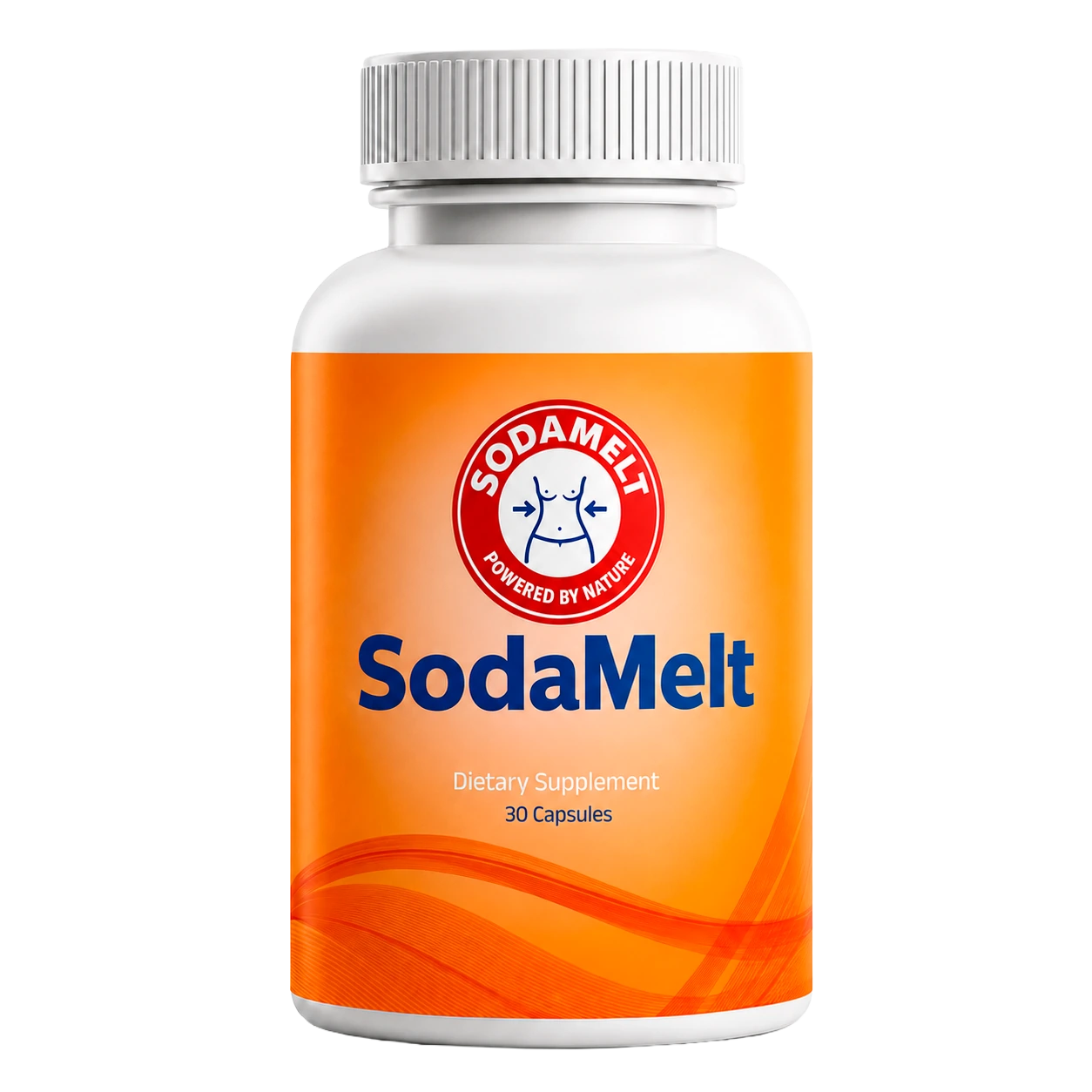
Order SodaMelt and test the one mark you can
Three marks describe a factory. The fourth is 60 days from the purchase date, and it is the only one a buyer can hold anyone to.
One bottle $89 · six bottles $294 · 60-day money-back guarantee
Order SodaMelt On The Official WebsiteOne capsule a day · 30 per bottle · lot SOD-26/MY-2226