SodaMelt Official Website › Blog › How to Read the SodaMelt Label: 7 Steps
SodaMelt® Ingredients List: How to Read the Label in 7 Steps
The SodaMelt ingredients list has twelve entries. Calcium (as calcium carbonate) has its own line at 100 mg. The other eleven share one 250 mg proprietary blend, listed heaviest first: oat straw, alfalfa, psyllium husk, Chinese rhubarb root, scabrous gentian root, aloe vera leaf, cascara sagrada bark, goldenseal root, buckthorn bark, bentonite and Lactobacillus acidophilus. No amount is printed for any single blend name. The other ingredients are rice flour, hypromellose, magnesium stearate and silicon dioxide.
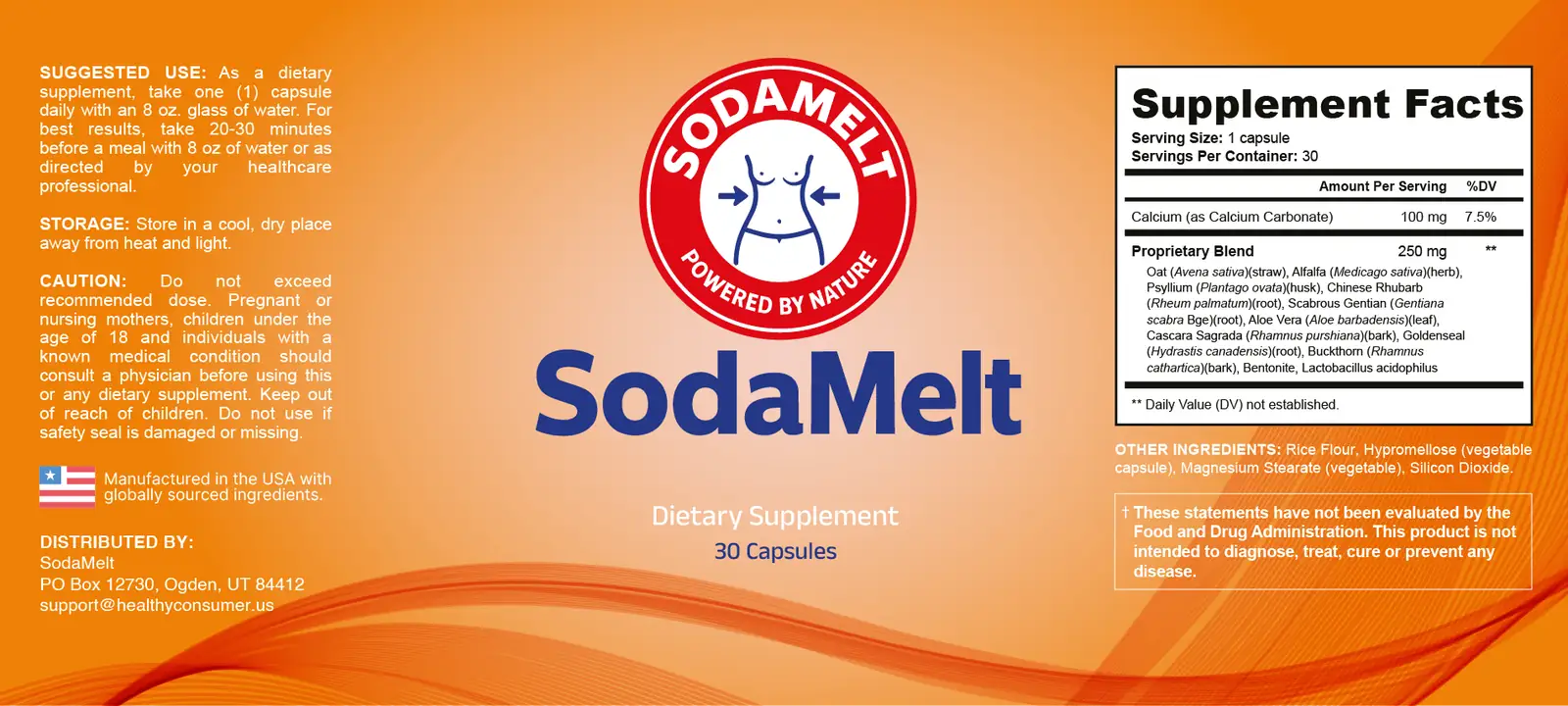
- Serving size is 1 capsule. Servings per container: 30.
- Two amounts are printed: Calcium (as Calcium Carbonate) 100 mg, 7.5% Daily Value, and Proprietary Blend 250 mg, Daily Value not established.
- Eleven names share the 250 mg blend, in descending order of weight under 21 CFR 101.36.
- Other ingredients: Rice Flour, Hypromellose (vegetable capsule), Magnesium Stearate (vegetable), Silicon Dioxide.
- Not published: an amount for any single blend name, and a CFU count for Lactobacillus acidophilus.
- The bottle prints no structure or function claim. SodaMelt is a dietary supplement and is not FDA approved.
SodaMelt is a dietary supplement. It is not a drug and it is not FDA approved, and no supplement is. These statements have not been evaluated by the Food and Drug Administration. This product is not intended to diagnose, treat, cure or prevent any disease. For a medical question, ask your doctor or pharmacist.
What is printed on the SodaMelt Supplement Facts panel?
Think of the panel as a short receipt. It has two lines with amounts and one list of names. Read in the right order, it tells you more than the front of the bottle does.
- Per capsule, calcium: the first row reads Calcium (as Calcium Carbonate), 100 mg, which is 7.5% of the Daily Value.
- Per capsule, the blend: the second row reads Proprietary Blend, 250 mg, and no Daily Value is established for it.
- Servings: one capsule is a serving, and a bottle holds 30 of them.
The seller’s own graphic lists these names around a picture of the bottle, which is useful for a first look. The panel on the carton is the document to trust, because it is the one printed on the product itself.
Step 1: What form is SodaMelt: capsule, pill, gummy or drops?
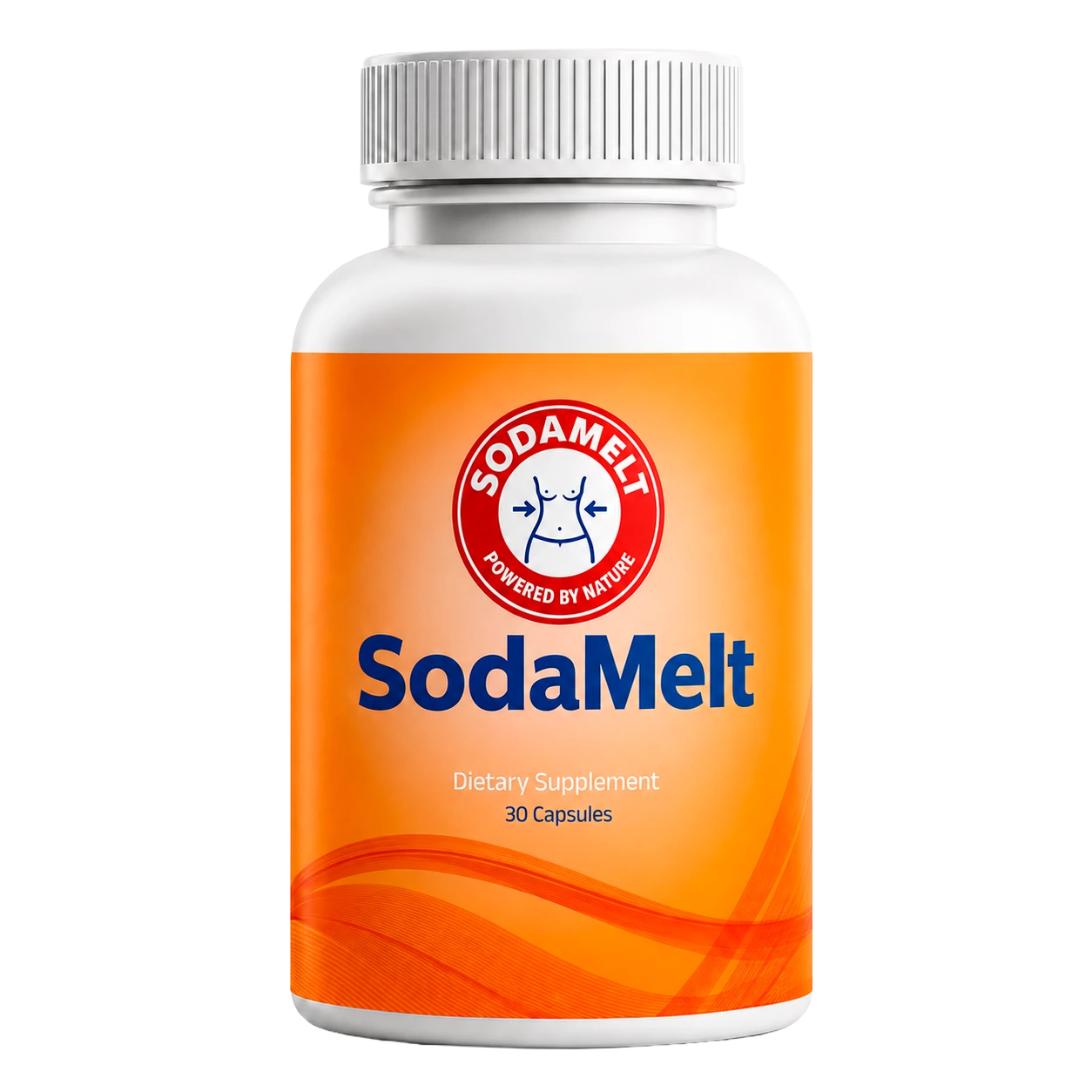
A capsule. The front of the bottle says Dietary Supplement and 30 Capsules, and the shell is hypromellose, which is plant-derived. It is not a gummy, a powder or liquid drops. If you saw those words in a search, they describe other products, not this one.
The word pill is common in searches. A capsule is a pill in everyday speech, and the label asks you to swallow it whole with a glass of water. The bottle does not address opening the capsule.
Step 2: What is the serving, and how long does a bottle last?
One capsule is one serving, and a bottle holds 30 servings. At the suggested use of one capsule daily, one bottle lasts 30 days. Everything on the panel is worked out for one capsule. So if a person took two, every row would double, including the four stimulant herbs and the calcium.
Read the suggested use right beside the panel. It asks for an 8 oz glass of water and for the capsule to be taken 20 to 30 minutes before a meal, or as your healthcare professional directs.
Compare the label with the page
Hold the bottle against the panel on this site, then check the live price and guarantee on the order page.
Seller’s printed prices: one bottle $89 · three bottles $177 · six bottles $294 · 60-day money-back guarantee
See today’s price and guaranteeThe checkout shows the live price. Disclosure: Mysodamelt earns a commission when you order through this button, and the site says your price does not change.
Step 3: What do the two panel rows tell you, and what do they hide?
Row one is plain. Calcium carbonate is declared at 100 mg and carries a 7.5% Daily Value. Row two is the interesting one. Eleven ingredients are tucked under the heading Proprietary Blend and share one total of 250 mg.
That format is legal and common. A blend only has to print its total and its list in weight order. The cost to the reader is that no one can say how many milligrams of psyllium, aloe or any other name are in a capsule. The site says this plainly and does not guess. For a sense of scale only, 250 mg shared evenly by 11 names would be about 23 mg each, but a formula is not usually split evenly.
Next to each blend name, write not published for the amount. If a page gives you a figure for one name, ask where it came from.
Step 4: What does the order of the eleven names tell you?
Position is the one quantitative fact the label gives for free. The first name is the heaviest and the last is the lightest. So oat straw outweighs alfalfa, alfalfa outweighs psyllium, and so on, down to the live culture.
| Place | Name as printed | Group |
|---|---|---|
| 1 | Oat, straw | Cereal plant part |
| 2 | Alfalfa, herb | Forage herb |
| 3 | Psyllium, husk | Bulk fibre |
| 4 | Chinese Rhubarb, root | Stimulant laxative (anthranoid) |
| 5 | Scabrous Gentian, root | Bitter root |
| 6 | Aloe Vera, leaf | Stimulant laxative (anthranoid) |
| 7 | Cascara Sagrada, bark | Stimulant laxative (anthranoid) |
| 8 | Goldenseal, root | Root that carries berberine |
| 9 | Buckthorn, bark | Stimulant laxative (anthranoid) |
| 10 | Bentonite | Adsorbent clay |
| 11 | Lactobacillus acidophilus | Live culture, no CFU count |
The four anthranoid herbs sit at places 4, 6, 7 and 9. That family works at tens of milligrams, a scale a 250 mg blend can plausibly hold (a review of anthranoid laxatives).
The label also prints the botanical names. For the four stimulants they are Rheum palmatum for the rhubarb root, Aloe barbadensis for the aloe leaf, Rhamnus purshiana for cascara bark and Rhamnus cathartica for buckthorn bark. A reader can check each against a plant reference.
Compare that with trial amounts: psyllium trials used more than 10 g a day (a 2022 meta-analysis of fibre supplementation), and probiotic trials used 3 to 8 billion CFU a day (a randomised trial of probiotic sachets). The label does not reach either figure.
Step 5: Why do plant parts matter on the SodaMelt label?
A plant name alone can mislead. The label gives the part, and the part changes the meaning. Two cases stand out.
- Aloe vera leaf, not gel. The laxative action comes from aloin in the yellow latex just under the leaf skin, and not from the clear inner gel (NCCIH on aloe vera).
- Oat straw, not oat bran. The beta-glucan results in the research come from oat bran and oatmeal, not from straw (a meta-analysis of oat beta-glucan).
So when a page tells you that oats or aloe are good for you, ask which part. The label has already told you.
Step 6: What are the other ingredients, and is the capsule vegetarian?
Under the panel the label prints four more names: Rice Flour, Hypromellose (vegetable capsule), Magnesium Stearate (vegetable) and Silicon Dioxide. They hold the capsule together and help powder flow through a machine. None of them is an active ingredient.
The shell is plant-derived and the magnesium stearate is described as vegetable, so a vegetarian reading is reasonable. The site is careful, though. The label itself makes no vegetarian or vegan claim, and the blend includes a bacterial culture. So that is a reading of the list, not a statement from the maker.
Step 7: What does the fine print say?
Four lines finish the label. The caution asks you not to exceed the dose and names three groups to consult a physician first. The storage line says to keep it cool, dry and away from heat and light. The origin line reads Manufactured in the USA with globally sourced ingredients. The distributor block reads SodaMelt, PO Box 12730, Ogden, UT 84412.
The bottle also carries the FDA paragraph. It says these statements have not been evaluated by the Food and Drug Administration, and that the product is not intended to diagnose, treat, cure or prevent any disease. The bottle prints no claim about what the capsule does. Every benefit you read about SodaMelt comes from the seller’s page, where it should be read as the seller’s own words.
Which sources does this post use?
Sources named on this site that this post draws on.
- A review of anthranoid laxatives – https://pubmed.ncbi.nlm.nih.gov/10215727/
- A 2022 meta-analysis of fibre supplementation – https://pubmed.ncbi.nlm.nih.gov/35816465/
- A randomised trial of probiotic sachets – https://pubmed.ncbi.nlm.nih.gov/36316826/
- NCCIH on aloe vera – https://www.nccih.nih.gov/health/aloe-vera
- A meta-analysis of oat beta-glucan – https://pubmed.ncbi.nlm.nih.gov/25411276/
Frequently asked questions
How many ingredients does SodaMelt have?
Twelve names appear on the panel: calcium as calcium carbonate on its own row, and eleven names inside one 250 mg proprietary blend.
How much psyllium is in SodaMelt?
Not published. The label gives psyllium a place, third of eleven by weight inside a 250 mg blend, but no milligram figure.
Is SodaMelt a capsule, a pill, a gummy or drops?
A capsule. The front of the bottle says 30 Capsules, and the shell is plant-derived hypromellose. Gummies, powders and drops are different products.
What else is in the capsule besides the blend?
Four other ingredients: rice flour, hypromellose (the vegetable capsule shell), vegetable magnesium stearate and silicon dioxide.
Does the SodaMelt label say how many live cultures it has?
No. Lactobacillus acidophilus is last of the eleven names and no CFU count is declared, so the amount is not knowable from the label.
Does the SodaMelt label say how long to take it?
No. The label prints a daily dose and a caution but no limit on the number of days.
Our view
We like this label for what it gets right. It prints a real panel, the plant parts, the binomial names, the other ingredients and a caution. A label that does that lets a careful buyer check the botany. Many bottles in this aisle do not.
We do not like what it leaves open: no amount for any blend name, no CFU count and no duration line beside the suggested use. Read those gaps as gaps and plan around them. If you take medicines or have a health condition, take the label to a doctor or pharmacist before the first capsule.
Read first, then order
The order page shows the live price, the shipping line and the 60-day guarantee terms before you pay.
Seller’s printed prices: one bottle $89 · three bottles $177 · six bottles $294 · 60-day money-back guarantee
See today’s price and guaranteeThe checkout shows the live price. Disclosure: Mysodamelt earns a commission when you order through this button, and the site says your price does not change.
Last updated . Medical review by Dr. Savita Srivastava, MD, .