SodaMelt Official Website › Blog › What 250 mg Of Eleven Ingredients Means
What 250 mg Shared Between Eleven Ingredients Actually Means
The SodaMelt panel prints one weight for eleven botanicals. That is lawful, it is ordinary, and it is also a number small enough to reason about. Turn it into something you can picture and the range of possible formulas narrows very fast.
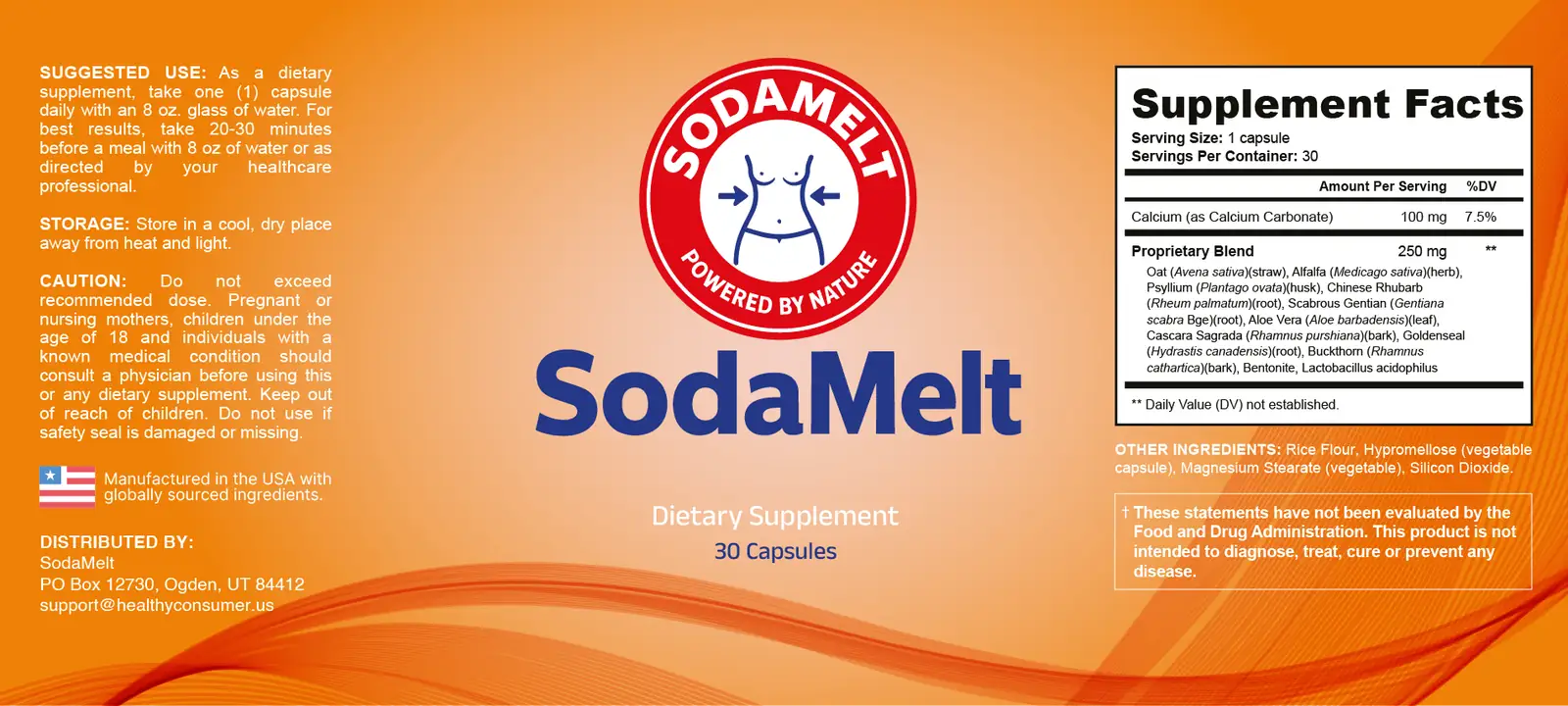
- 250 mg is about five grains of uncooked rice. That is the total botanical content of one capsule.
- Divided evenly the eleven would get 22.7 mg each, and no formulator divides a blend evenly.
- Three of the eleven belong to families whose research runs in grams, so no plausible split reaches those amounts.
- One family on the panel works at tens of milligrams, and it is the only one a 250 mg budget can pay for.
- The panel withholds the split and declares the order, and the order is enough to rule several formulas out.
Two hundred and fifty milligrams, in things you can picture
Milligrams are a unit almost nobody has an intuition for, which is part of why supplement panels are hard to read. A figure that looks substantial on a carton can be a quantity you would struggle to see on a table.
Two hundred and fifty milligrams is about a quarter of a gram. In kitchen terms that is roughly five grains of uncooked rice, or a heap of powder that would sit comfortably on the flat of a fingernail with room to spare. It is a real quantity and it is not a large one.
That is the whole botanical content of one capsule. Everything else inside the shell is calcium carbonate at 100 mg and the four inactive ingredients printed under the panel, of which rice flour is doing the bulking.
| Quantity | Roughly equal to | Where it turns up on this label |
|---|---|---|
| 250 mg | A quarter of a paperclip, or five grains of uncooked rice | The entire botanical blend, shared by eleven ingredients |
| 100 mg | A twelfth of the calcium in a large glass of milk | The calcium row, which is the only figure printed on its own |
| 22.7 mg | A fortieth of a level quarter-teaspoon | What each of the eleven would weigh on an even split |
| 10 g | Two heaped teaspoons of husk powder | The daily psyllium dose in the constipation meta-analysis |
| 120 g | A small cupful of seeds | The daily alfalfa dose in the lipid study |
The left-hand column is arithmetic; the middle column is a comparison offered so the figures stop being abstract. Only the first two are printed on the bottle.
Reading down that table is the fastest way to understand this label. Two of the five rows are printed on the bottle and three of them come from published research, and the gap between the two groups is not subtle.
The even split, and why nobody builds a blend that way
The simplest assumption is that eleven ingredients share 250 mg equally, which works out at 22.7 mg each. It is worth doing the sum once, because it sets a ceiling: no ingredient in this blend can weigh less than a trace and the heaviest cannot weigh more than the whole.
No formulator would actually do it. Blends are built to a cost and to an intended effect, and an even split achieves neither. Cheap bulk material goes in generously; expensive or potent material goes in sparingly.
The even split is still useful as a thought experiment. If every ingredient got 22.7 mg, nothing on this panel would reach a researched amount, including the laxative family at the bottom of its own range. That tells you the real formula has to be lopsided in order to do anything at all.
The lopsided split, and what the order implies
Under 21 CFR 101.36 the ingredients inside a proprietary blend are listed in descending order of weight. That is not a courtesy; it is a requirement, and it is the one piece of quantitative information the declaration leaves behind.
So position one outweighs position two, which outweighs position three, down to eleven. On this label that order runs: oat straw, alfalfa herb, psyllium husk, Chinese rhubarb root, scabrous gentian root, aloe vera leaf, cascara sagrada bark, goldenseal root, buckthorn bark, bentonite, Lactobacillus acidophilus.
| If the 250 mg were divided like this | What it would mean | Is it plausible |
|---|---|---|
| Evenly, 22.7 mg each | Nothing in the blend reaches a researched amount, including the anthranoids at the low end of their range | No formulator divides a blend evenly |
| Front-loaded onto positions one to three | Oat straw, alfalfa and psyllium take most of the weight, and all three need grams | Possible, and it would make the blend almost inert |
| Concentrated on the anthranoid positions | Rhubarb, aloe, cascara and buckthorn reach the tens of milligrams their compounds work at | Consistent with what buyers report happening |
| Spread with the culture last and smallest | The Lactobacillus at position eleven is a trace, and no count is declared anyway | Whatever the split, this row cannot be assessed |
Four hypothetical divisions. The panel declares the order and withholds the split, so none of these can be confirmed; what the order does is rule some of them out.
Four candidate divisions, and the table is honest about what can be settled. The panel does not say which is right. What the order does is make the second and third rows more likely than the first, and it tells you which ingredients are competing for the top of the budget.
What the weight order rules out
Three of the eleven have well-defined research doses and all three of them are enormous relative to 250 mg.
Psyllium sits third by weight. The updated meta-analysis of fibre supplementation in chronic constipation found its effect above 10 g a day (a 2022 meta-analysis of fibre supplementation). Ten grams is forty times the entire blend, so psyllium at position three is a fortieth of a fortieth at best.
Alfalfa sits second. The human lipid work used 40 g of heat-prepared seeds three times a day, which is 120 g (the alfalfa seed trial). Oat sits first, and every beta-glucan result came from bran or oatmeal at 3 g of beta-glucan a day (a meta-analysis of oat beta-glucan) rather than from straw.
Goldenseal at position eight has been given at around 3 g a day in the small studies that exist (NCCIH). The culture at position eleven declares no count at all, and the trials with results behind them used 3 to 8 billion organisms a day (a randomised trial of probiotic sachets).
- Oat straw, first by weight, needs grams and belongs to a different part of the plant
- Alfalfa herb, second, needs a small cupful of seeds to reproduce its published result
- Psyllium husk, third, needs more than forty times the entire blend
- Goldenseal root, eighth, has been studied at around twelve times the entire blend
- Lactobacillus acidophilus, eleventh, declares no count, so no assessment is possible
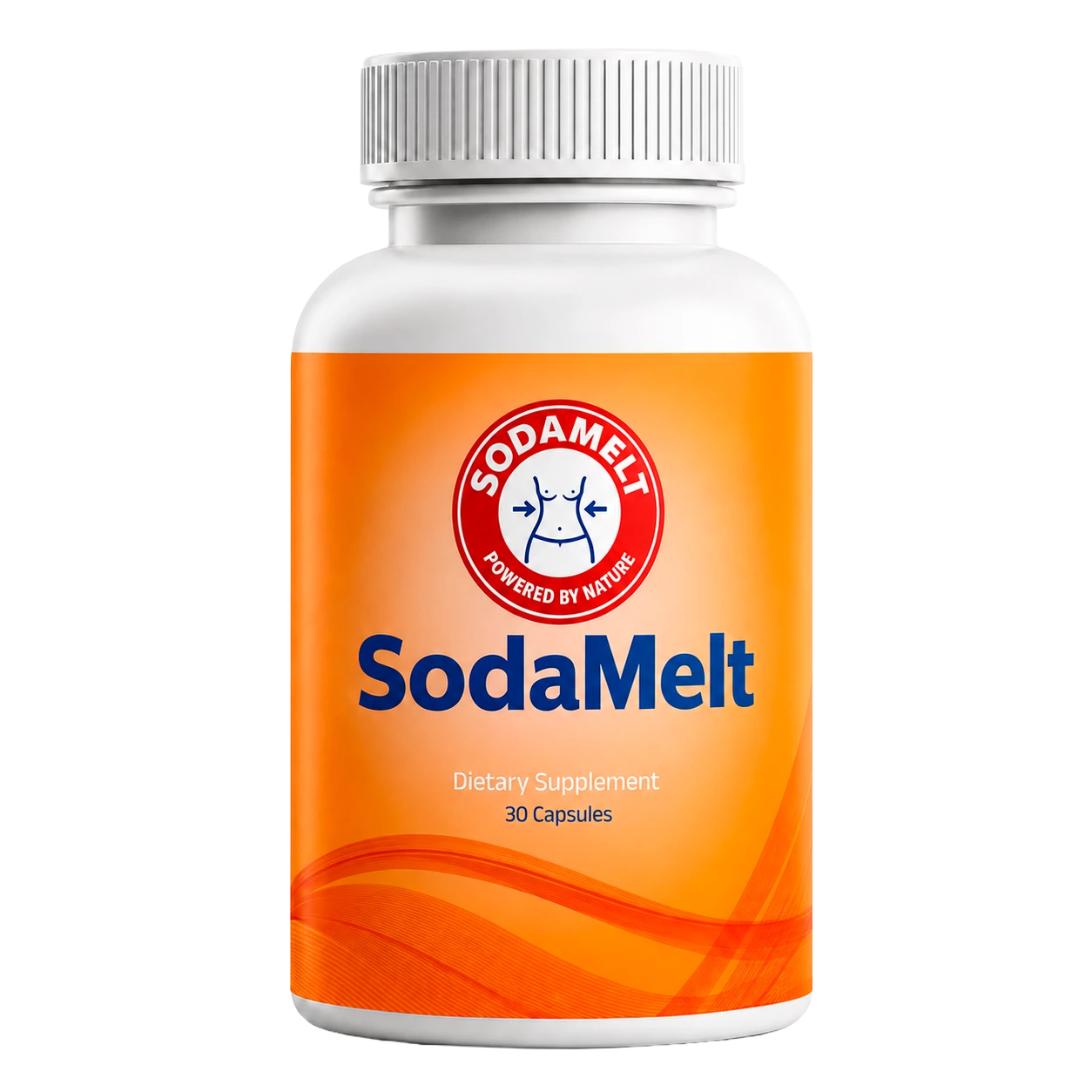
See the SodaMelt panel transcribed in full
Two rows, twelve names and the weight order, read off the carton rather than paraphrased. The window is 60 days from the purchase date.
One bottle $89 · six bottles $294 · 60-day money-back guarantee
Order SodaMelt On The Official WebsiteOne capsule a day · 30 per bottle · lot SOD-26/MY-2226
The one family the budget can pay for
Positions four, six, seven and nine are Chinese rhubarb root, aloe vera leaf, cascara sagrada bark and buckthorn bark. All four are anthranoid-bearing plants, and anthranoid glycosides are active in tens of milligrams rather than in grams (a review of anthranoid laxatives).
That is the entire reason this arithmetic is worth doing. A 250 mg budget cannot pay for a fibre dose or a seed dose or a culture count, and it can comfortably pay for four anthranoid rows.
It is also why the effect people report is the effect they report. An anthranoid reaches the colon largely unchanged, bacteria there free the active compound, and the result arrives six to twelve hours later. Nothing about that requires grams.
Nobody outside the formulator knows what the four anthranoid rows weigh, and this reasoning does not produce a figure. It establishes which families are in range and which are not, which is a smaller and much more defensible claim.
Why the calcium row is the giveaway
Calcium as calcium carbonate is printed at 100 mg with its own Daily Value percentage. It is the only ingredient on this bottle with a figure of its own, and the reason is regulatory: calcium has an established Daily Value, so it cannot hide inside a blend.
What makes it interesting is the size. One hundred milligrams is a modest amount of calcium, roughly a twelfth of what a day's reference intake looks like, and it sits outside the blend entirely.
Put the two rows together and the shape of the capsule becomes clear. A small, declared mineral dose, a small botanical budget, and a bulking agent making up the volume. That is a coherent product; it is simply a narrower one than twelve names on a panel suggests.
What would make this panel assessable
None of the changes below is expensive and three of them are a matter of printing information the manufacturer already holds.
- A milligram figure per row, which turns every one of the eleven from a name into a quantity
- A colony-forming unit count for the culture, with the strain designation and the date it is guaranteed to
- A measured anthraquinone total, which would be the single most informative number this product could publish
- A duration line beside the suggested use, which every over-the-counter product in the same ingredient class prints
Until then, the weight order is what a reader has, and it is more than nothing. It rules out the fibre story, the seed story and the beta-glucan story, and it points at the one family that fits.
That is what this website means when it says the panel is the most useful surface on the bottle. Everything else is a claim; the panel is a constraint.
References
- van Gorkom BA, de Vries EG, Karrenbeld A, et al. Review article: anthranoid laxatives and their potential carcinogenic effects. Aliment Pharmacol Ther. 1999;13(4):443-52. PMID 10215727. https://pubmed.ncbi.nlm.nih.gov/10215727/
- van der Schoot A, Drysdale C, Whelan K, et al. The Effect of Fiber Supplementation on Chronic Constipation in Adults: An Updated Systematic Review and Meta-Analysis of Randomized Controlled Trials. Am J Clin Nutr. 2022;116(4):953-969. PMID 35816465. https://pubmed.ncbi.nlm.nih.gov/35816465/
- Mølgaard J, von Schenck H, Olsson AG. Alfalfa seeds lower low density lipoprotein cholesterol and apolipoprotein B concentrations in patients with type II hyperlipoproteinemia. Atherosclerosis. 1987;65(1-2):173-9. PMID 3606731. https://pubmed.ncbi.nlm.nih.gov/3606731/
- Whitehead A, Beck EJ, Tosh S, et al. Cholesterol-lowering effects of oat beta-glucan: a meta-analysis of randomized controlled trials. Am J Clin Nutr. 2014;100(6):1413-21. PMID 25411276. https://pubmed.ncbi.nlm.nih.gov/25411276/
- Mitelmão FCR, Höckel K, Bergamaschi CC, et al. The effect of probiotics on functional constipation in adults: A randomized, double-blind controlled trial. Medicine (Baltimore). 2022;101(43):e31185. PMID 36316826. https://pubmed.ncbi.nlm.nih.gov/36316826/
- National Center for Complementary and Integrative Health. Goldenseal: Usefulness and Safety. Read 19 September 2026. States that there is not enough evidence to determine whether goldenseal is useful for any health condition, that study doses were about 3 g a day, that it should not be used in pregnancy or breastfeeding, and that metformin levels fell about 25% in healthy adults given goldenseal extract with metformin. https://www.nccih.nih.gov/health/goldenseal