SodaMelt Official Website › Blog › Alfalfa At Position Two
Alfalfa At Position Two: The Herb, The Amino Acid And The Arithmetic
Alfalfa has two research reputations that pull in opposite directions. Fed as seeds, it lowered cholesterol in a small human trial. Fed as sprouts, it produced a lupus-like syndrome in monkeys. Both were done with a material and an amount that a 250 mg capsule cannot match, and this article puts numbers on how far apart they are.
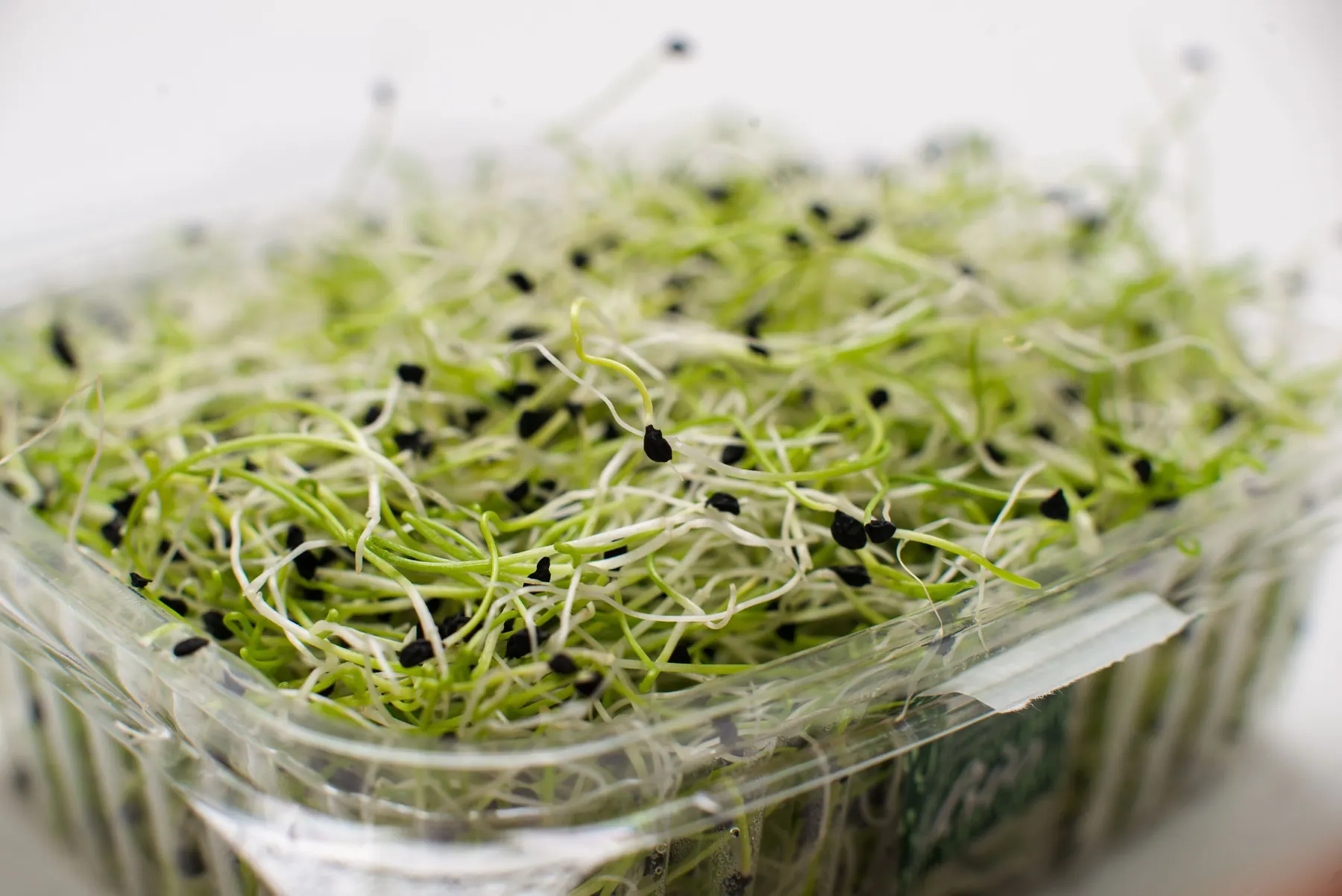
- The panel lists alfalfa second of eleven, as "Alfalfa (Medicago sativa)(herb)", inside a 250 mg proprietary blend with no amount printed for it.
- The human cholesterol trial gave 40 g of heat-prepared seeds three times a day, 120 g in all. The whole SodaMelt blend is 0.25 g.
- The lupus concern centres on L-canavanine, an amino acid in alfalfa. The best-known measurement of it in alfalfa tablets is 25 to 34 micrograms per gram.
- Even if the entire blend were alfalfa, that measurement implies roughly 6 to 8 micrograms per capsule, a small fraction of what the reported cases involved. It is arithmetic, not a safety guarantee.
- Two groups should still ask before the first capsule: anyone with lupus, and anyone taking warfarin.
What the word herb is doing on this panel
Read the second row of the blend and it says Alfalfa (Medicago sativa)(herb). Three pieces of information sit in that line: a common name, a Latin name, and a plant part. The plant part is the one most readers skip, and with alfalfa it matters more than usual.
Alfalfa is sold and studied in at least three forms. There are the seeds, which are what people ate by the handful in the cholesterol work. There are the sprouts, the thin white-and-green shoots from a salad bar. And there is the herb, meaning the dried above-ground plant, leaves and stems, which is what ends up in tablets, teas and blends. Different forms carry different amounts of the same chemicals.
The Drugs and Lactation Database, known as LactMed and hosted by the National Library of Medicine, describes the plant this way: its leaves and sprouts contain saponins, estrogenic isoflavonoids such as daidzein and genistein, vitamin K, and the amino acid L-canavanine (the LactMed entry on alfalfa). Three of those four things are the ones this article is about, so it is worth keeping the list in view. It also says the plant is generally recognised as safe as a food, which is a useful reminder that nothing here is an accusation. Alfalfa is a forage crop and a salad ingredient.
The question is narrower than whether alfalfa is safe to eat. It is whether the two famous research literatures about alfalfa say anything about a capsule that contains an unstated share of 250 milligrams of it.
The cholesterol work, and the amount it needed
The positive reputation comes from lipid research done mostly in the late 1970s and early 1980s. Rabbits fed diets with alfalfa saponins or 40 percent alfalfa seeds had less hypercholesterolaemia and less aortic sudanophilia, which is fat staining in the aorta, over four months (the rabbit study). Cynomolgus macaques given alfalfa top saponins absorbed less cholesterol and excreted more bile acids in their stool (the macaque balance study). The authors of the macaque paper were careful to add that long-term toxicity work was needed before anyone recommended it to people.
Then came a human trial. Fifteen patients with high blood lipids ate 40 g of heat-prepared alfalfa seeds three times a day, at mealtimes, for eight weeks, with the rest of their diet unchanged (the alfalfa seed trial). In the patients with type II hyperlipoproteinaemia, median LDL cholesterol fell from 7.69 to 6.33 mmol/l, an 18 percent drop, and total cholesterol fell 17 percent. Everything returned to the starting values after treatment stopped. Body weight crept up in the first month, which the authors put down to the calories in the seeds.
Two things about that trial are easy to lose when it is quoted in a sentence. It was 15 people, and the abstract describes no placebo group. And the dose was not a supplement dose at all. It was a food dose.
| Quantity | Alfalfa material | Where the figure comes from |
|---|---|---|
| 120 g a day | Heat-prepared seeds, in three servings of 40 g | The 15-patient cholesterol trial |
| 0.25 g a day | The entire blend, all eleven names, dried herb among them | The SodaMelt Supplement Facts panel |
| 0.023 g a day | The even split: 250 mg divided across 11 names | Arithmetic on the same panel |
Three quantities with the same unit. The trial dose is 480 times the whole blend, and more than five thousand times the even-split share of a single name.
The arithmetic is not subtle. Even if the blend contained nothing but alfalfa, the capsule would carry a 480th of the trial dose. On an even split it carries about a 5,300th. There is no reading of the panel under which the cholesterol literature is describing this capsule, and the bottle itself prints no benefit claim of any kind. That is worth saying plainly, because alfalfa's cholesterol reputation is easy to carry from a trial into a product page without the dose coming along.
The other literature: sprouts, monkeys and an amino acid
The less comfortable half of alfalfa's record starts with one of the same research groups. In 1982, Science published an experiment in which cynomolgus macaques fed alfalfa sprouts developed blood and serological abnormalities similar to human systemic lupus erythematosus. When L-canavanine sulfate was added to the diet, it reactivated the syndrome in monkeys that had previously developed it from alfalfa seeds or sprouts (the Science paper on monkeys and alfalfa sprouts). Canavanine is a non-protein amino acid, and it closely resembles arginine.
A 1983 letter in the New England Journal of Medicine then reported an exacerbation of lupus associated with alfalfa ingestion (the case letter). A 1985 laboratory study found that canavanine, in dish experiments, changed how human immune cells behave: it reduced the response of lymphocytes to certain stimulants and removed the activity of suppressor cells, in cells from healthy donors and from lupus patients alike (the T-cell study). The authors argued this could explain why alfalfa might trigger or worsen lupus.
What has happened in the decades since is more measured. A 2006 review describes the mechanism as plausible, in that canavanine can be built into proteins in place of arginine, producing misshapen proteins. It also states that induction or worsening of lupus by alfalfa tablets, reported in a few cases, "remains controversial", and that epidemiological studies of the relationship are sparse (the review of canavanine in autoimmunity). Mouse strains prone to lupus worsened on canavanine; one of the strains tested did not.
An animal experiment with sprouts, a handful of case reports, and a mechanistic story that is credible but unconfirmed in people. Not nothing, and not a proven hazard at supplement doses. For a person who already has lupus, that combination is exactly the kind of thing to raise with the doctor who manages it before starting a new botanical.
See where alfalfa sits on the SodaMelt panel
Second of eleven inside a 250 mg blend, ahead of psyllium and Chinese rhubarb root. The ingredients page lists every name in weight order.
One bottle $89 · six bottles $294 · 60-day money-back guarantee
Order SodaMelt On The Official WebsiteOne capsule a day · 30 per bottle · lot SOD-26/MY-2226
The canavanine arithmetic, worked on this panel
How much canavanine does an alfalfa product actually carry? One answer exists from 1984. A laboratory ground ten alfalfa tablets, extracted the powder, and measured canavanine by liquid chromatography. The tablets averaged 25.3 and 33.8 micrograms per gram, depending on lot and extraction method. Because ten tablets were the recommended daily amount, that was about 0.18 mg of canavanine a day. The paper also mentioned two patients whose lupus flared while they were taking 15 and 8 of those tablets a day, which the authors converted to 0.27 and 0.15 mg of canavanine, and said whether it was the canavanine that did it was uncertain (the canavanine assay of alfalfa tablets).
Those numbers can be laid against this panel. The maximum possible alfalfa content of one SodaMelt capsule is the whole 250 mg blend. The plausible content is far lower, because ten other names share it.
| Scenario | Alfalfa per capsule | Canavanine at 25.3 to 33.8 µg/g |
|---|---|---|
| Ceiling: the whole blend is alfalfa | 250 mg | About 6.3 to 8.5 µg |
| Even split across 11 names | 22.7 mg | About 0.6 to 0.8 µg |
| The 1984 tablet regimen | Ten tablets a day | About 180 µg |
| The smaller of the two patient intakes | Eight tablets a day | About 150 µg |
Arithmetic only. It applies a 1984 measurement of three alfalfa tablet samples to a different product, so it shows scale, not this bottle's true content.
At the ceiling, the capsule would carry about a twentieth of the daily canavanine in the 1984 tablet regimen, and about an eighteenth of the smaller patient intake. On any realistic split, it is a good deal less than that. This is the calculation a proprietary blend permits and the only one it permits: an upper bound, worked from the total.
The caveats deserve equal space. The measurement is more than 40 years old and covers three samples of a tablet product, not herb from the field. Canavanine content varies with plant part, age and growing conditions. The animal experiments used seeds and sprouts, not dried herb. And nobody has published a dose below which canavanine is known to be harmless for a person with lupus. What the arithmetic supports is a proportion, not a promise.
What position two does and does not imply
The federal rule for blends, 21 CFR 101.36, lists the ingredients in descending order of weight. That puts alfalfa second, behind oat straw and ahead of psyllium, rhubarb root and everything else. Under that convention it is likely one of the larger shares of the 250 mg, which is why the ceiling row in the table above is a more useful worst case than the even split.
It is still a small share of a small number. The whole logic of the 250 mg divided eleven ways article applies here: a name being high on the list tells you it is not the smallest, and nothing more. The label does not print a milligram figure for alfalfa, and nothing in the research above allows one to be inferred.
Whether the position is good news depends on the reader. For someone worried about canavanine, a low share is reassuring. For someone hoping the alfalfa row does something, a low share is a reason to lower expectations. The same fact reads both ways, which is what a blend does to every row on it.
Vitamin K, and the one medicine it touches
The same reference entry that mentions canavanine carries a second, separate caution: because of its vitamin K content, alfalfa should be avoided in people taking warfarin (the LactMed entry on alfalfa). Warfarin works by opposing vitamin K, and anyone on it is normally advised to keep their vitamin K intake steady rather than swinging it up and down.
The entry does not quantify how much alfalfa matters, and this article cannot either, because the amount in one capsule is unknown. The practical reading is short. If you take warfarin, say so to whoever manages your anticoagulation before starting anything with alfalfa on the list. They can decide whether the row matters at this weight, and they can arrange a blood test if it might.
That belongs beside the other two conversations this panel raises: goldenseal and the prescription list, and the timing of levothyroxine against calcium described in the calcium article. Three different rows, three different medicines, and none of them is printed on the bottle. The bottle's own caution asks anyone with a known medical condition to consult a physician first, which covers all three without naming any.
What this article is not saying
It is not saying SodaMelt causes lupus, because nothing here supports that. It is not saying alfalfa is dangerous, because it is a commonplace food and forage crop. And it is not saying the alfalfa row is decoration, because it may well be the second-largest share of the blend.
What it does say is narrower and checkable. The cholesterol figure is 120 g and the capsule is 0.25 g. The best-documented canavanine measurement puts a fully alfalfa capsule at roughly a twentieth of a regimen that was linked, in a few case reports, to lupus flares. The unknowns are the amount, the material and the batch. All three could be narrowed if the seller published them, and none can be narrowed from the panel.
The one thing a buyer can do is ask. The batch verification page explains how to request the certificate of analysis for the lot on the bottle, and identity testing for the botanical inputs is a normal part of one. A row that says herb is a claim about a plant part, and a certificate is where a claim like that gets checked.
Four questions to bring to any alfalfa row
- Which part of the plant? Seeds, sprouts and dried herb are three different materials with different chemistry.
- How much? Alfalfa research runs from 0.18 mg of canavanine to 120 g of seeds. A row with no figure could sit anywhere on that range, though a blend total sets a ceiling.
- Do I have lupus or another autoimmune condition? If so, ask the clinician who treats it.
- Do I take warfarin? If so, the vitamin K point is for the person managing your dose, not for a label.
Those four questions travel. They work on a tablet of alfalfa in a health shop as well as on this capsule, and they are more useful than any verdict on any single bottle.
References
- Alfalfa. Drugs and Lactation Database (LactMed). Bethesda (MD): National Institute of Child Health and Human Development; 2006-. Read 26 September 2026. PMID 30000890. https://pubmed.ncbi.nlm.nih.gov/30000890/
- Malinow MR, McLaughlin P, Stafford C, Livingston AL, Kohler GO. Alfalfa saponins and alfalfa seeds. Dietary effects in cholesterol-fed rabbits. Atherosclerosis. 1980;37(3):433-8. PMID 7458987. https://pubmed.ncbi.nlm.nih.gov/7458987/
- Malinow MR, Connor WE, McLaughlin P, Stafford C, Lin DS, Livingston AL, et al. Cholesterol and bile acid balance in Macaca fascicularis. Effects of alfalfa saponins. J Clin Invest. 1981;67(1):156-62. PMID 7451648. https://pubmed.ncbi.nlm.nih.gov/7451648/
- Mölgaard J, von Schenck H, Olsson AG. Alfalfa seeds lower low density lipoprotein cholesterol and apolipoprotein B concentrations in patients with type II hyperlipoproteinemia. Atherosclerosis. 1987;65(1-2):173-9. PMID 3606731. https://pubmed.ncbi.nlm.nih.gov/3606731/
- Malinow MR, Bardana EJ, Pirofsky B, Craig S, McLaughlin P. Systemic lupus erythematosus-like syndrome in monkeys fed alfalfa sprouts: role of a nonprotein amino acid. Science. 1982;216(4544):415-7. PMID 7071589. https://pubmed.ncbi.nlm.nih.gov/7071589/
- Roberts JL, Hayashi JA. Exacerbation of SLE associated with alfalfa ingestion. N Engl J Med. 1983;308(22):1361. PMID 6843625. https://pubmed.ncbi.nlm.nih.gov/6843625/
- Alcocer-Varela J, Iglesias A, Llorente L, Alarcón-Segovia D. Effects of L-canavanine on T cells may explain the induction of systemic lupus erythematosus by alfalfa. Arthritis Rheum. 1985;28(1):52-7. PMID 3155617. https://pubmed.ncbi.nlm.nih.gov/3155617/
- Akaogi J, Barker T, Kuroda Y, Nacionales DC, Yamasaki Y, Stevens BR, et al. Role of non-protein amino acid L-canavanine in autoimmunity. Autoimmun Rev. 2006;5(6):429-35. PMID 16890899. https://pubmed.ncbi.nlm.nih.gov/16890899/
- Weissberger LE, Armstrong MK. Canavanine analysis of alfalfa extracts by high performance liquid chromatography using pre-column derivatization. J Chromatogr Sci. 1984;22(10):438-40. PMID 6501526. https://pubmed.ncbi.nlm.nih.gov/6501526/