SodaMelt Official Website › Blog › The One Disclosed Dose
The One Number On This Label: What 100 mg Of Calcium Carbonate Does
Every other ingredient on this panel hides inside a 250 mg blend. Calcium carbonate does not — it gets its own row, its own milligram figure and its own Daily Value percentage. That makes it the only ingredient here you can actually reason about with real numbers, so it is worth taking seriously: what 100 mg does, what it can interact with, and why a supplement built around a digestive complaint contains an antacid mineral at all.
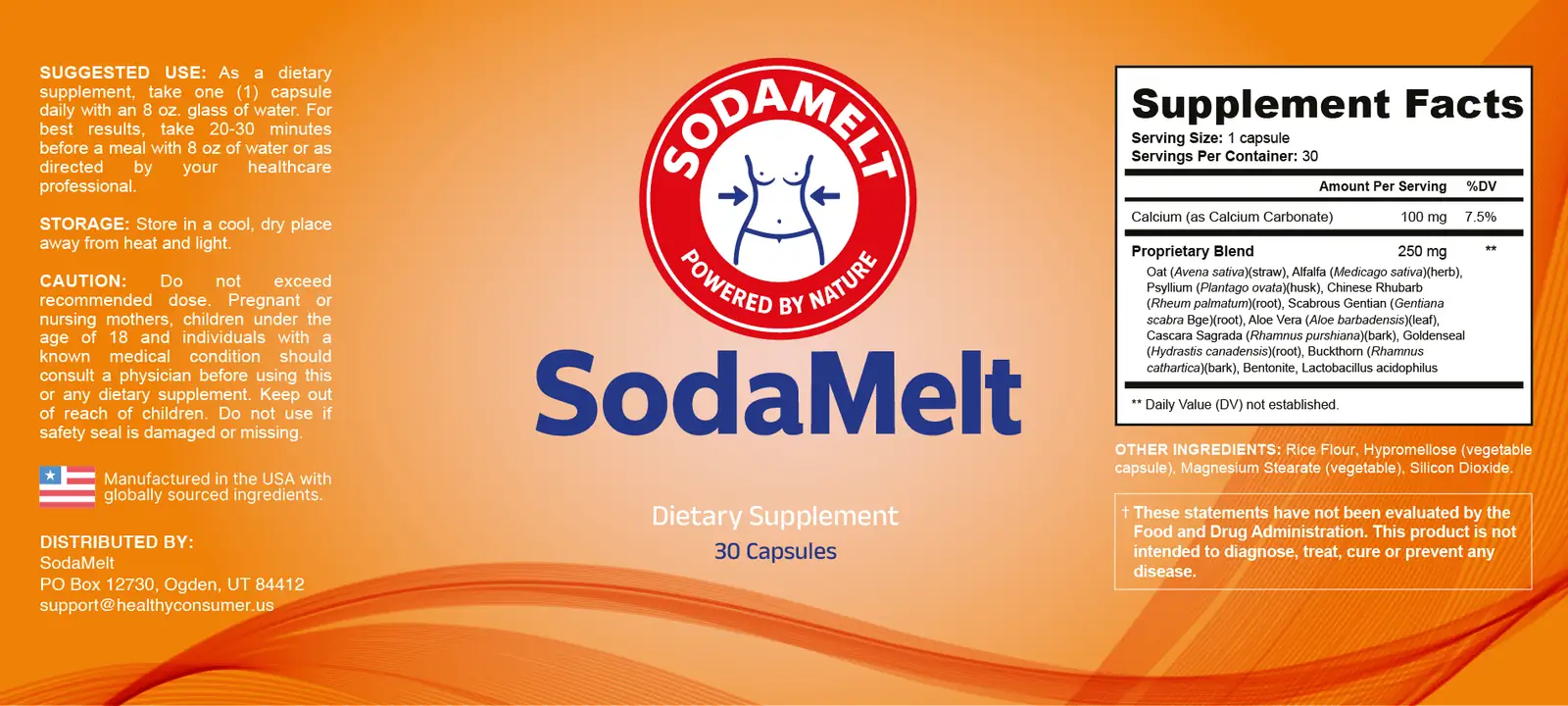
- 100 mg of calcium carbonate is roughly 7.5% of the adult Daily Value for calcium, a small fraction of a day’s intake, not a full supplement dose.
- Calcium carbonate is the same compound used in over-the-counter antacids, and it works the same way here as it does there: it neutralizes stomach acid.
- Calcium carbonate has been shown in controlled studies to reduce the absorption of levothyroxine, a thyroid medication, by roughly a fifth to a quarter when taken together.
- Taken well past the amount on this label, calcium carbonate has caused milk-alkali syndrome, a real and published complication of antacid overuse, though nothing here suggests one capsule a day approaches that range.
- The panel discloses this ingredient because federal rules require an amount for any nutrient with an established Daily Value. Everything else on the panel lacks that requirement, which is why it hides inside the blend instead.
Why this row has a number and the others don’t
Under FDA labelling rules, a proprietary blend can list its ingredients by name and weight order without disclosing individual amounts, which is exactly what this panel does for its eleven botanicals, the bentonite and the probiotic. Calcium does not get that option. Any nutrient with an established Daily Value — calcium, potassium, vitamin C and the rest of the standard nutrient panel — has to be declared with its own milligram amount and its own percentage of that Daily Value, blend or no blend.
That single rule is why this row looks different from every other row on the label. It is not that the manufacturer chose to be more transparent about calcium specifically; it is that the law does not give them a choice on this one ingredient the way it does on the other twelve names.
What calcium carbonate actually does in the body
Calcium carbonate is a mineral salt, the same compound that makes up limestone and chalk. In the body it does two distinct things depending on where it acts. In the stomach, its carbonate component reacts with hydrochloric acid, neutralizing it directly — this is the exact mechanism behind over-the-counter antacid tablets, which are frequently pure calcium carbonate at doses of 500–1,000 mg per tablet. Once past the stomach, the calcium ion itself is absorbed in the small intestine and used for the ordinary jobs calcium does everywhere in the body: bone mineralization, muscle contraction, nerve signalling and blood clotting.
| Figure | What it represents |
|---|---|
| 100 mg | Calcium content of this capsule, as printed |
| 7.5% | Share of the adult Daily Value (1,300 mg) that 100 mg represents |
| ~1,000–2,500 mg | Typical single-dose range for calcium carbonate sold specifically as an antacid |
| 1,300 mg | FDA adult Daily Value for calcium used to calculate the 7.5% figure |
The antacid dose range is a general description of over-the-counter calcium carbonate antacid products as a category, not a claim about any single branded product.
Why an antacid mineral is in a digestion blend
SodaMelt’s botanical blend leans heavily on anthranoid-bearing plants — Chinese rhubarb, aloe vera, cascara sagrada and buckthorn, covered on this site’s other posts — which work as stimulant laxatives. Stimulant laxatives are well known to cause cramping as a common side effect, because they work by triggering intestinal muscle contraction rather than by adding bulk. A small dose of an acid-neutralizing mineral alongside that kind of blend is a plausible formulation choice for taking the edge off stomach discomfort, though the label does not say this is the reason and this website cannot confirm the formulator’s intent.
It is also possible the calcium is there simply because a nutrient with a declared Daily Value looks reassuring on a Supplement Facts panel, next to a blend of botanicals that discloses nothing else. Both explanations are consistent with what is printed; neither can be confirmed from the label alone.
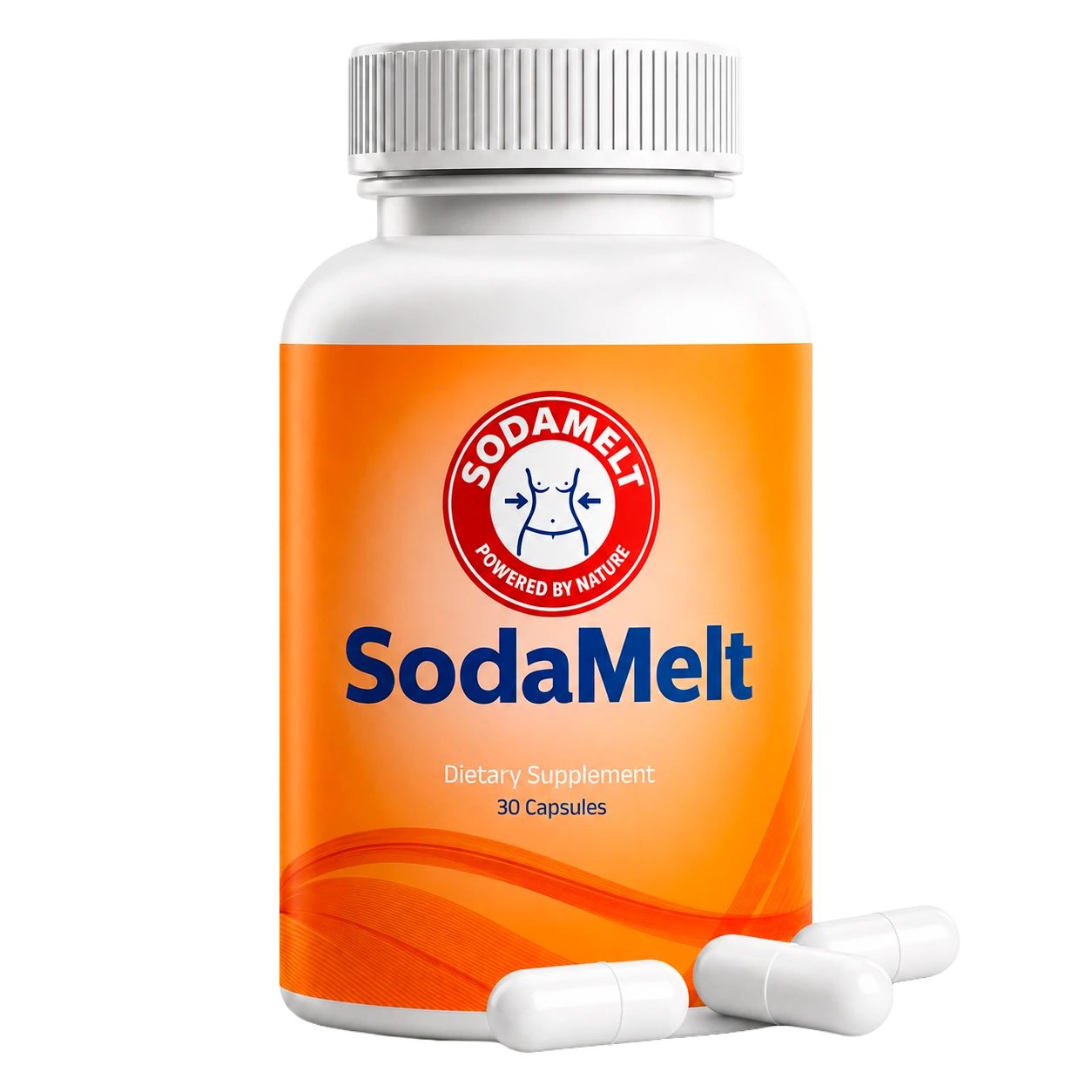
See the SodaMelt panel transcribed in full
One declared mineral, eleven botanical names sharing a single blend total. The window is 60 days from the purchase date.
One bottle $89 · six bottles $294 · 60-day money-back guarantee
Order SodaMelt On The Official WebsiteOne capsule a day · 30 per bottle · lot SOD-26/MY-2226
What it can interfere with
Calcium carbonate’s best-documented drug interaction is with levothyroxine, the thyroid hormone replacement millions of people take daily. A controlled pharmacokinetic study in healthy adults found that coadministering calcium carbonate, calcium citrate or calcium acetate each reduced levothyroxine absorption by roughly 20–25% compared with taking the thyroid medication alone (Zamfirescu & Carlson, 2011). A separate cohort study of fifty postmenopausal women on long-term levothyroxine found that when they began taking calcium supplementation within two hours of their thyroid dose, TSH rose significantly, 18% developed clinically elevated TSH, and their cholesterol, fasting glucose and blood pressure all moved in the wrong direction — effects that reversed once calcium intake was postponed six to eight hours after the levothyroxine dose (Morini et al., 2019). A 2021 systematic review of levothyroxine interactions with food and supplements confirms calcium carbonate as one of the better-established interactions in this category (Wiesner et al., 2021).
None of these studies used a dose as small as 100 mg specifically — the levothyroxine absorption study used 500 mg of elemental calcium, five times what this capsule contains. The mechanism, though, is not obviously dose-gated below that point: calcium carbonate’s interference with levothyroxine absorption works by forming an insoluble complex in the gut, and the smaller amount here would plausibly cause a smaller effect rather than none at all. This website cannot state a specific reduction figure for 100 mg because no study has tested that exact amount; the honest range is somewhere below the 20–25% seen at 500 mg, and it is illustrative rather than measured.
The standard clinical advice, regardless of the exact dose, is to separate any calcium supplement from a levothyroxine dose by at least four hours. Anyone taking thyroid medication alongside this capsule should apply that spacing and mention the supplement to whoever manages their thyroid prescription.
How far 100 mg is from a problem dose
Calcium carbonate’s other well-documented risk, milk-alkali syndrome, is a real but dose-driven complication of sustained, heavy antacid use. A 2026 case report describes a 42-year-old man who developed hypercalcaemia, metabolic alkalosis and acute kidney injury after chronic overuse of calcium carbonate tablets for reflux, requiring IV fluids and bisphosphonate treatment before his calcium normalized (Varghese et al., 2026). Milk-alkali syndrome is associated with sustained calcium carbonate intake well into the multi-gram range, taken repeatedly as an antacid rather than as a once-daily supplement dose — the case report does not specify the man’s exact daily total, but it describes “chronic overuse” of tablets taken for symptom relief, the pattern typical of this condition.
One SodaMelt capsule contains 100 mg of calcium carbonate, roughly a fortieth to a hundredth of a typical single antacid dose and a small fraction of the daily totals reported in milk-alkali cases. Nothing about this product’s labelled dose puts a normal user in that range. The case report is included here because it defines the far end of what calcium carbonate can do at high, sustained intake, not because 100 mg approaches it.
Why the form of calcium matters here too
Calcium carbonate has one more property worth knowing about, separate from the antacid and interaction questions above: it needs stomach acid to dissolve. Calcium salts like calcium carbonate are poorly soluble on their own, and gastric acid is what ionizes them into the form the small intestine can actually absorb. A review of hypochlorhydria — a low-stomach-acid state caused by atrophic gastritis, gastric surgery or long-term use of acid-suppressing drugs such as proton pump inhibitors — concludes that all three conditions can markedly reduce dissolution of calcium carbonate specifically, and flags this as a plausible long-term contributor to osteoporosis risk in affected patients (Sipponen & Härkönen, 2010).
That mechanism cuts in a specific direction for this product. This capsule’s own botanical blend is built around stimulant laxatives that act on the colon, not the stomach, so it does not itself suppress gastric acid. But anyone taking this capsule while also on a long-term antacid, an H2 blocker or a proton pump inhibitor for an unrelated condition is exactly the population the review describes: someone whose stomach may not acidify the 100 mg of calcium carbonate here enough to absorb it well. For that group, the 7.5% Daily Value figure printed on the panel is likely an overstatement of what actually reaches the bloodstream, not an understatement.
What this means for how you take the capsule
Three practical points follow directly from the numbers above, all of them things a reader can act on without needing a lab result:
- If you take levothyroxine or another thyroid medication, take it at least four hours away from this capsule, matching the standard advice given for any calcium-containing product.
- 100 mg is not a meaningful calcium supplement on its own. Anyone taking this product for bone health or general calcium intake should not count on it to move the needle; it is 7.5% of a day’s target.
- The calcium row is the one part of this label you can actually verify against outside sources, because it is the one part with a number attached. Where this website has compared a printed figure against a Daily Value or a study dose, that comparison is only possible here and on the sodium, if present, for exactly this reason.
References
- Zamfirescu I, Carlson HE. Absorption of levothyroxine when coadministered with various calcium formulations. Thyroid. 2011;21(5):483-6. PMID 21595516. https://pubmed.ncbi.nlm.nih.gov/21595516/
- Morini E, Catalano A, Lasco A, Morabito N, Benvenga S. L-thyroxine malabsorption due to calcium carbonate impairs blood pressure, total cholesterolemia, and fasting glycemia. Endocrine. 2019;64(2):284-292. PMID 30368654. https://pubmed.ncbi.nlm.nih.gov/30368654/
- Wiesner A, Gajewska D, Paśko P. Levothyroxine Interactions with Food and Dietary Supplements-A Systematic Review. Pharmaceuticals (Basel). 2021;14(3):206. PMID 33801406. https://pubmed.ncbi.nlm.nih.gov/33801406/
- Varghese S, Cinnamond K, Malek B, McMonagle E, Casserly L. Antacid Abuse - A Case of Milk-Alkali Syndrome. Ir Med J. 2026;119(5):88. PMID 42180434. https://pubmed.ncbi.nlm.nih.gov/42180434/
- Sipponen P, Härkönen M. Hypochlorhydric stomach: a risk condition for calcium malabsorption and osteoporosis? Scand J Gastroenterol. 2010;45(2):133-8. PMID 19958055. https://pubmed.ncbi.nlm.nih.gov/19958055/