The Four Other Ingredients Under The Panel: Rice Flour, Hypromellose, Magnesium Stearate, Silicon Dioxide
Under the Supplement Facts box, in smaller type, the SodaMelt label carries one more line: Other ingredients: Rice Flour, Hypromellose (vegetable capsule), Magnesium Stearate (vegetable), Silicon Dioxide. It is the line almost everyone skips. This article reads it slowly: what each of the four is there to do, what published work says about how they behave inside a capsule, and what the line leaves unsaid.
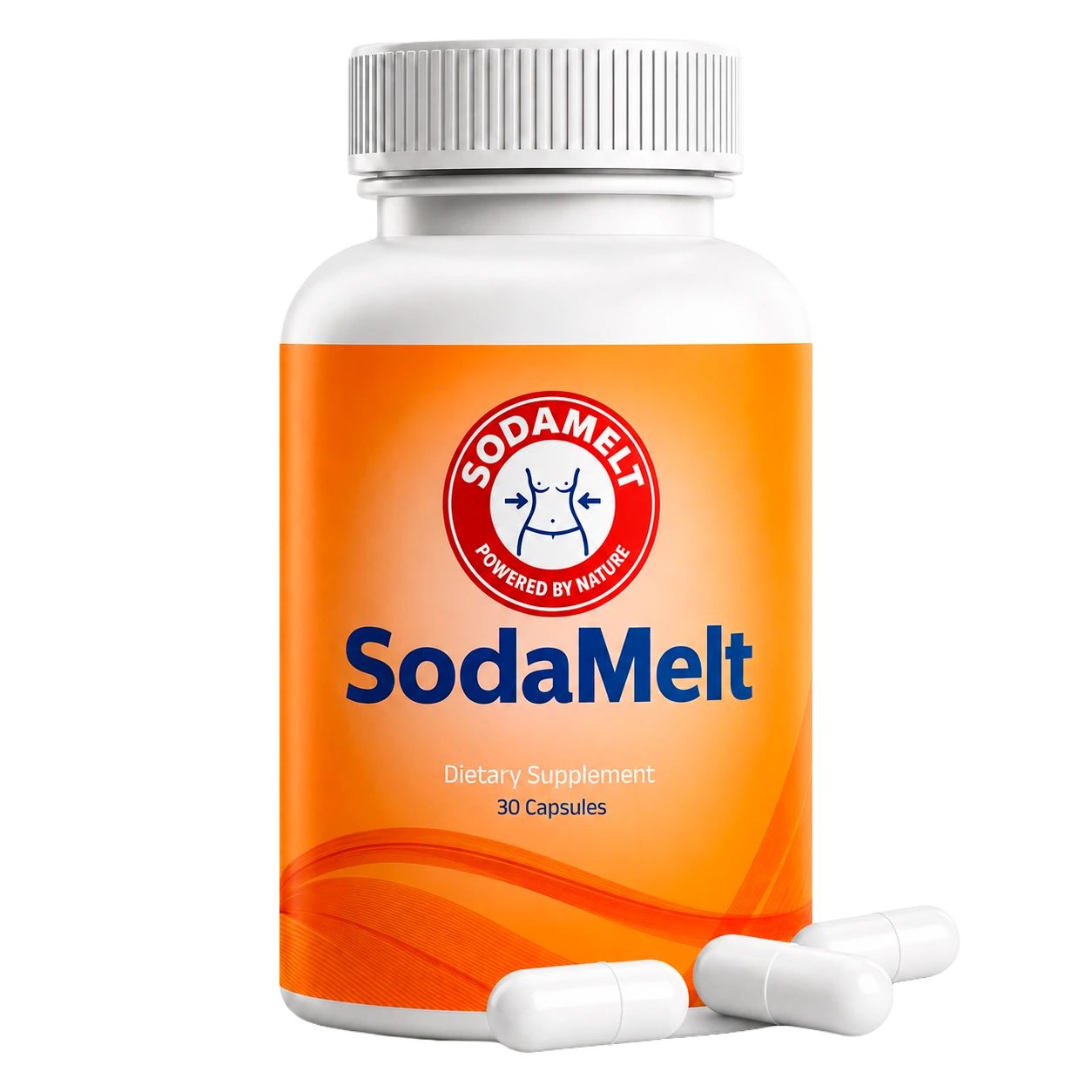
- The line names four things and gives no amounts. Nothing on the carton says how much rice flour, magnesium stearate or silicon dioxide a capsule holds, or what the finished capsule weighs.
- Hypromellose is the shell. In eight fasted volunteers, hypromellose and gelatin capsules both opened in the stomach within minutes, at about 9 and 7 minutes on average, and the gap was not statistically significant.
- Shell and contents can interact. A green tea extract released at once from gelatin capsules but not from the hypromellose ones tested, and slow release in acid from one hypromellose type was traced to a gelling agent. The label does not say which construction this is.
- Magnesium stearate is a lubricant with a documented side effect in tablets: it can slow dissolution, depending on how much is used and how it is mixed. The amount here is not printed.
- The line prints no gluten or allergen statement, so it cannot be read as one. It is a list of materials, not a claim.
- None of this is an accusation. These are ordinary capsule ingredients, and the useful thing is to know what the line does and does not say.
What the line is, and where it sits
The SodaMelt panel is short. The serving size is one capsule, a container holds 30 servings, and there are two rows: calcium (as calcium carbonate) at 100 mg, printed as 7.5% of the Daily Value, and a Proprietary Blend of 250 mg holding eleven named ingredients, with Daily Value not established. That is everything inside the box. Directly beneath it, outside the box, sits the line this article is about:
Other ingredients: Rice Flour, Hypromellose (vegetable capsule), Magnesium Stearate (vegetable), Silicon Dioxide.
Three things follow from where it sits. First, it is outside the box, so it carries no amounts and no percentage. Second, it lists four names, and the carton does not say whether the order means anything. The blend above it is printed in descending order of weight, but the carton makes no such statement about this line. Third, two of the four carry a small parenthetical, and both are about material rather than function. Vegetable capsule tells you the shell is plant-derived, and vegetable after magnesium stearate tells you the stearate is.
The word people use for this line is inactive, and it is a slightly misleading word. It means these are not the reason the product exists. It does not mean they have no properties of their own. A 2019 analysis in Science Translational Medicine set out the abundance and complexity of the so-called inactive ingredients in approved oral medications and concluded that a majority of the medications contain ingredients that could cause adverse reactions, which the authors took as a reason to maximise the tolerability and safety of these ingredients too (the analysis of inactive ingredients). That was a study of drugs, not supplements, and it does not single out any of these four. It is simply the reason to read the line at all rather than skip it.
Rice flour: the entry with no stated job
Of the four, rice flour is the one whose purpose the carton gives no hint about. The conventional job of a bland plant powder in a capsule is to be a filler or a carrier. It adds bulk, and it helps a small quantity of active material fill a shell evenly instead of rattling around in it. That is an inference from how capsules are ordinarily made, and it is only an inference. The label does not say it, and none of the sources checked for this article studies rice flour in this product.
What can be worked out from the label is narrower, and mostly consists of what cannot be worked out. The panel declares 100 mg of calcium and a 250 mg blend. It does not declare the capsule size, the fill weight, or the amount of rice flour. So there is no way to say whether the rice flour is a pinch or the largest single thing in the capsule by weight. Anyone who has wondered how a capsule holding eleven botanicals and a mineral can be so small is asking the same question, and this line is where part of the answer would be printed if it were printed anywhere.
One small point of accuracy on the word rice. Rice does not contain gluten, but a naturally gluten-free ingredient is not the same as a gluten-free claim. A claim needs a statement on the label, and that comes up again below.
Hypromellose: what a vegetable capsule is
Hypromellose is the generic name for hydroxypropyl methylcellulose, usually shortened to HPMC. It is a polymer made from cellulose, the structural material of plants, and on this label it is the shell. The parenthetical, vegetable capsule, tells you the shell is not gelatin. Two-piece hard capsules, a body and a cap that slide together around a powder, have traditionally been gelatin, so a plant-derived alternative is the reason the phrase is printed.
Why would a maker choose it? One answer sits in a 2010 paper on the qualification of a hypromellose capsule that contained no gelling agent. It compared the new shell with gelatin capsules and with a hypromellose capsule that did contain a gelling agent, carrageenan, and reported that the new one was better on mechanical strength, on hygroscopicity, meaning how readily it takes up moisture, and on compatibility with a wide range of drugs and excipients (the first qualification paper). The abstract also recounts the development history of the shell, which tells you the paper comes from the people who developed it. Read it as a specification sheet. It is a useful one, but it is not an independent verdict, and it concerns one product.
That last phrase is the important one. Hypromellose on a label is a family name, not a single recipe, and the next section shows why that matters.
Read the whole label, then decide about SodaMelt
Two rows, eleven blend entries in weight order, four other ingredients and one capsule a day with an 8 oz glass of water.
Order SodaMeltWhat studies of capsule shells found
Four published studies are worth setting beside the phrase vegetable capsule. None of them tested SodaMelt. Each tested capsules of the same general kind, and together they show what a shell can and cannot be assumed to do.
Does it open?
The first question anyone asks about a shell is whether it opens. In a scintigraphy study, eight healthy men fasted overnight and then swallowed size 0 capsules, one gelatin and one hypromellose containing carrageenan as a gelling agent, both filled with a lactose-based mixture and radiolabelled, with 180 ml of water. A gamma camera followed them for 30 minutes. Both types reached the stomach within seconds and all of them disintegrated there. The mean disintegration time was 9 minutes for the hypromellose capsules, with a range of 6 to 11, and 7 minutes for gelatin, with a range of 3 to 13. The difference was not statistically significant (P=0.108), and the authors concluded that both showed rapid and comparable disintegration in the fasted state (the scintigraphic study). Eight men is a small sample and the fill was lactose, but it is a direct look at what happens in people, not just in a beaker.
Does temperature or acidity matter?
An earlier bench study looked at how quickly empty shells dissolve as the medium and temperature change. In any medium with a pH at or below 5.8, the hypromellose shells dissolved rapidly, and it made no difference whether the liquid was 10 degrees or 55 degrees Celsius. Gelatin shells, by contrast, generally did not dissolve below 30 degrees. Every shell was slower and more variable in a phosphate buffer at pH 6.8. The authors' practical advice was that capsule products should not be taken with cola-type drinks, that gelatin ones are better with a warm drink, and that hypromellose ones can be taken with cold or warm (the shell dissolution study). The same paper has a line that connects to the carton. A short spell of storage under hot, humid conditions did not appear to change gelatin shells, but it did appear to influence the hypromellose shell matrix. The SodaMelt label asks for storage in a cool, dry place away from heat and light. That is ordinary advice for any supplement, and here it has a small piece of specific support behind it.
Is the gelling agent a difference?
A second paper from the same qualification programme compared two hypromellose capsules, one with carrageenan and one made without any gelling agent. In acid, 0.1 M hydrochloric acid, the carrageenan-containing shell released drug slowly, which the authors attributed to an interaction between the carrageenan and the compounds. In buffers containing potassium ions, which promote gelling of carrageenan, capsule opening was delayed and varied more from capsule to capsule. In other media the two performed comparably, and the small difference in rupture time did not show up in vivo (the second qualification paper). The lesson for a reader is a plain one. The single word hypromellose covers at least two constructions, and the label does not say which one this is.
Does the content matter?
The last study is the most relevant to a botanical product. Researchers put a green tea extract into simple powder-in-capsule formulations using either gelatin or hypromellose shells and tested disintegration and dissolution. Everything disintegrated within 30 minutes, meeting the USP criteria for botanical formulations. But gelatin gave immediate release in every medium tested and the hypromellose capsules did not. Release was especially impaired from one hypromellose type at pH 1.2, and from both hypromellose types in a fed-state intestinal medium. The authors suggested an interaction between the catechins in the extract and the shell material, and recommended assessing in vitro dissolution before releasing any dietary supplement (the green tea capsule study). That is evidence about one extract and it says nothing about oat, alfalfa, psyllium or the rest of this blend. What it does establish is that the shell is not automatically inert with respect to what is inside it, and that nobody can tell from a label alone.
| Question | What the studies found | What it does not settle for SodaMelt |
|---|---|---|
| Do the shells open in the stomach? | Yes, hypromellose and gelatin in fasted men, about 9 and 7 minutes, no significant difference | Which hypromellose type this is, and what the contents do to it |
| Do temperature and acidity matter? | Hypromellose dissolved quickly at pH 5.8 or below across 10 to 55 degrees; gelatin did not below 30 degrees | The label gives no water temperature, and any effect at the printed 8 oz is not measured |
| Does a gelling agent change release? | In one shell type, slower release in acid and delayed opening with potassium | Whether this capsule contains one |
| Can contents slow a hypromellose shell? | Yes, in one green tea extract study | Whether any of these eleven botanicals does |
Four questions a reader might ask about the shell, and where each stops. All four studies tested other products.
What the shell means for a psyllium and probiotic blend
Two entries in the blend make the shell more interesting than it would be on a plain vitamin: psyllium at position three, and Lactobacillus acidophilus at position eleven.
Start with the timing, because the scintigraphy result gives a working picture. With an ordinary shell, the powder inside meets stomach fluid within minutes of swallowing. The carton asks for one capsule with an 8 oz glass of water, which is about 237 ml, 20 to 30 minutes before a meal. That is broadly like the study's setting, though not identical, since the volunteers fasted overnight and drank 180 ml. Nothing on the label suggests a delayed-release design. A capsule built to hold its contents until the intestine would usually say so, with words such as delayed-release or enteric-coated, and this label uses neither. The phrase vegetable capsule describes the material of the shell, not the timing of it.
For the probiotic, that leaves nothing to calculate with. The carton prints no CFU count, no strain, and no statement that the shell protects the culture. This article makes no claim about how many bacteria reach the bowel alive, because no figure on the label allows one and there is no study of this product to cite. The blend arithmetic is worked in the article on what 250 mg shared between eleven ingredients means.
For psyllium the shell is a footnote. Psyllium needs water because it swells in it, and the 8 oz instruction is where the carton addresses that. Hypromellose neither adds to that need nor removes it. The article on why psyllium is dosed in grams explains why the amount that can fit in one capsule is small.
Magnesium stearate: the lubricant
Magnesium stearate is a lubricant, and the label adds the word vegetable, which says the stearic acid behind it comes from a plant fat and not an animal one. In production a powder has to move: it has to flow into a machine, fill a shell evenly and not stick to the equipment. A little magnesium stearate helps with all of that. In a study that mixed four lubricants into spray-dried lactose, magnesium stearate gave the best improvement in flowability, even at the low amounts normally added (the lubricant flowability study).
Now the side effect, which is real and documented, and is the reason this ingredient has a reputation. Magnesium stearate is hydrophobic, meaning it repels water. A review of lubrication in tablet manufacture notes that the presence of a lubricant can change the physical and chemical properties of the tablet, and it devotes a good deal of space to the manufacturing factors that decide how much lubrication actually takes place (the review of lubrication). A study of ranitidine tablets, comparing cores made with 0.77 percent and 1.1 percent magnesium stearate, found different dissolution profiles by the standard similarity test and pointed to the compound's ability to form films on other ingredients during prolonged mixing, which prolongs release and lengthens disintegration time (the study of two concentrations). A mechanistic study found that the delay comes from magnesium stearate becoming exposed on the tablet surface as it dissolves, and that it was stronger in acid than in neutral medium, which the authors attributed to stearic acid forming there and being less soluble than the salt (the study of delay in acid).
Every one of those is about tablets, which are compressed, whereas this product is a loosely filled capsule. So the direction of the effect is documented, and its size for a capsule with an unstated amount is not. You may have seen magnesium stearate described online as something that blocks absorption. The kernel of truth is the dissolution finding above. What was not found in the sources checked is a demonstration that the amounts used in a capsule change how much of a supplement's ingredients a person absorbs, and this article will not manufacture one.
One more data point shows that the compound is not merely a lab curiosity. A method paper developed a way of measuring magnesium stearate in capsule and tablet supplements and found levels above 2,500 micrograms per gram, which is 0.25 percent by weight, in 5 of 25 supplements tested, which the authors read as possible deliberate admixture (the supplement assay paper). The takeaway is only that magnesium stearate is common, measurable and usually added on purpose. The carton for this product does not print how much.
Silicon dioxide: the flow agent
Silicon dioxide is silica, the compound that makes up most of ordinary sand, prepared here as a very fine powder. In capsules it is used as a glidant, an additive that helps other powders flow. A study using microscopy found that colloidal silicon dioxide improved the flow of microcrystalline cellulose, and it explained why. The fine silica particles sit on the surface of the larger particles and reduce the force with which they stick together. Measured by atomic force microscopy, the adhesion force was 44.8 nanonewtons for the cellulose alone, 25.2 and 28.3 for two hydrophilic silica types, and 13.8 for a hydrophobic type under gentle mixing (the study of glidant mechanism).
Two cautions on that. The powder tested was cellulose, not a botanical blend, so it is a demonstration of mechanism, not a description of this capsule. And the paper shows that colloidal silica comes in different types with different behaviour, while the label says only Silicon Dioxide, without naming a type. The plain reading is that silicon dioxide keeps a mixed powder from clumping so the capsule fills reliably, but the label does not state the purpose, and, like the others, it prints no amount.
What the line does not tell you
The most useful way to read an ingredient line is to list the questions it cannot answer.
| A reader's question | Does the line answer it? | What is printed instead |
|---|---|---|
| How much of each is in a capsule? | No | Nothing; the line is outside the panel and carries no amounts |
| Is the shell hypromellose with or without a gelling agent? | No | Hypromellose (vegetable capsule) |
| Is the capsule delayed-release? | No | No such term appears on the carton |
| Is the product gluten-free or free of a named allergen? | No | No such statement is printed |
| What grade or type of silicon dioxide, or which plant fat for the stearate? | No | Silicon Dioxide, and Magnesium Stearate (vegetable) |
| Does the line make any benefit claim? | No | It is a list of materials |
Six things this line leaves open, transcribed from the carton and checked against the Supplement Facts page.
The allergen point deserves a little more room. Excipients are where allergens and intolerance triggers can hide, and the literature says so. A 2025 study of 308 medicinal products authorised in Portugal found gluten-derived excipients listed in 44.4 percent of the paracetamol-containing analgesics and antipyretics it examined, and soy-derived ones in 14 percent of the ibuprofen products, and its authors called for clearer allergen labelling (the study of gluten and soy excipients). That study is about medicines in another country and it says nothing about this capsule. A review in the allergy literature makes a complementary point: reactions to excipients are rare, common culprits include gelatin, carboxymethylcellulose, polyethylene glycols and propylene glycol, and working out a suspected reaction requires the full list of ingredients (the review of excipient hypersensitivity). Gelatin appears on that list and it is not in this capsule. None of the four names on this label is on it.
So a reader who avoids gluten or a particular allergen has a practical route: ask the distributor named on the carton for a written statement, and do not treat the ingredient line as one. That is not a criticism of this label, since most supplement labels are the same. It is the honest limit of what a list of four names can tell you.
Keeping it in proportion
It would be easy to write an alarming article about this line, and it would be wrong. Rice flour, hypromellose, magnesium stearate and silicon dioxide are among the most ordinary things printed on capsule supplements and drugs alike. Nothing in the sources above suggests any of the four is hazardous at the amounts a capsule uses. Their documented effects are about how a powder flows and how a shell or tablet releases what is inside, which are manufacturing and performance questions, not toxicity findings.
If you were ranking the things worth knowing about this bottle, this line would sit well below the questions on the panel itself: that eleven ingredients share 250 mg, that four of them are stimulant-laxative plants, and that the probiotic has no stated count. Those are dealt with in the articles linked from the blog index and on the Supplement Facts page. The other-ingredients line earns its place for a few specific readers: people who want to avoid animal-derived capsules, people who need a written allergen statement, and people who like to know what shell they are swallowing and how it should be stored.
What to take from it, in five lines:
- The four names are a list of materials with no amounts, and they make no claim.
- The shell is a plant-derived polymer that opens in the stomach within minutes, and hypromellose covers more than one construction.
- Magnesium stearate is a common lubricant whose documented effect is on dissolution in tablets, at amounts the label does not print.
- Silicon dioxide helps powders flow, and the label does not say which type.
- For a gluten or allergen question, get a written answer rather than reading one into the list.
References
- Sherry Ku M, Li W, Dulin W, Donahue F, Cade D, Benameur H, et al. Performance qualification of a new hypromellose capsule: part I. Comparative evaluation of physical, mechanical and processability quality attributes of Vcaps Plus, Quali-V and gelatin capsules. Int J Pharm. 2010;386(1-2):30-41. PMID 19900518. https://pubmed.ncbi.nlm.nih.gov/19900518/
- Ku MS, Lu Q, Li W, Chen Y. Performance qualification of a new hypromellose capsule: Part II. Disintegration and dissolution comparison between two types of hypromellose capsules. Int J Pharm. 2011;416(1):16-24. PMID 21356291. https://pubmed.ncbi.nlm.nih.gov/21356291/
- Tuleu C, Khela MK, Evans DF, Jones BE, Nagata S, Basit AW. A scintigraphic investigation of the disintegration behaviour of capsules in fasting subjects: a comparison of hypromellose capsules containing carrageenan as a gelling agent and standard gelatin capsules. Eur J Pharm Sci. 2007;30(3-4):251-5. PMID 17188473. https://pubmed.ncbi.nlm.nih.gov/17188473/
- Chiwele I, Jones BE, Podczeck F. The shell dissolution of various empty hard capsules. Chem Pharm Bull (Tokyo). 2000;48(7):951-6. PMID 10923822. https://pubmed.ncbi.nlm.nih.gov/10923822/
- Glube N, Moos Lv, Duchateau G. Capsule shell material impacts the in vitro disintegration and dissolution behaviour of a green tea extract. Results Pharma Sci. 2013;3:1-6. PMID 25755998. https://pubmed.ncbi.nlm.nih.gov/25755998/
- Wang J, Wen H, Desai D. Lubrication in tablet formulations. Eur J Pharm Biopharm. 2010;75(1):1-15. PMID 20096779. https://pubmed.ncbi.nlm.nih.gov/20096779/
- Morin G, Briens L. The effect of lubricants on powder flowability for pharmaceutical application. AAPS PharmSciTech. 2013;14(3):1158-68. PMID 23897035. https://pubmed.ncbi.nlm.nih.gov/23897035/
- Uzunović A, Vranić E. Effect of magnesium stearate concentration on dissolution properties of ranitidine hydrochloride coated tablets. Bosn J Basic Med Sci. 2007;7(3):279-83. PMID 17848158. https://pubmed.ncbi.nlm.nih.gov/17848158/
- Ariyasu A, Hattori Y, Otsuka M. Delay effect of magnesium stearate on tablet dissolution in acidic medium. Int J Pharm. 2016;511(2):757-64. PMID 27444551. https://pubmed.ncbi.nlm.nih.gov/27444551/
- Uematsu Y, Ogimoto M, Kabashima J, Ito K, Yasuda K. Determination of magnesium stearate in capsule- or tablet-type supplements. J AOAC Int. 2006;89(2):458-61. PMID 16640294. https://pubmed.ncbi.nlm.nih.gov/16640294/
- Jonat S, Hasenzahl S, Gray A, Schmidt PC. Mechanism of glidants: investigation of the effect of different colloidal silicon dioxide types on powder flow by atomic force and scanning electron microscopy. J Pharm Sci. 2004;93(10):2635-44. PMID 15349972. https://pubmed.ncbi.nlm.nih.gov/15349972/
- Reker D, Blum SM, Steiger C, Anger KE, Sommer JM, Fanikos J, et al. "Inactive" ingredients in oral medications. Sci Transl Med. 2019;11(483). PMID 30867323. https://pubmed.ncbi.nlm.nih.gov/30867323/
- Caballero ML, Krantz MS, Quirce S, Phillips EJ, Stone CA Jr. Hidden Dangers: Recognizing Excipients as Potential Causes of Drug and Vaccine Hypersensitivity Reactions. J Allergy Clin Immunol Pract. 2021;9(8):2968-2982. PMID 33737254. https://pubmed.ncbi.nlm.nih.gov/33737254/
- Figueiredo A, Auxtero MD, Brás A, Casimiro A, Costa IM. Presence of gluten and soy derived excipients in medicinal products and their implications on allergen safety and labeling. Sci Rep. 2025;15(1):10976. PMID 40164820. https://pubmed.ncbi.nlm.nih.gov/40164820/