SodaMelt Official Website › Blog › What The Constipation Guideline Says
What The 2023 Constipation Guideline Says About Fibre And Stimulants
When a capsule is sold for a sluggish bowel, the fair question is what the specialists' own guidance says works, at what dose, and how sure they are. In 2023 the two US gastroenterology societies published exactly that document for adults with chronic constipation. This article lays it beside the SodaMelt panel.
- The guideline is a joint American Gastroenterological Association and American College of Gastroenterology document on the pharmacological management of chronic idiopathic constipation in adults, published in 2023.
- It reviewed fibre, three osmotic laxatives, three stimulant laxatives, three secretagogues and one serotonin agonist. It made strong recommendations for five drugs and conditional ones for five more, fibre and senna among them.
- Senna is the only stimulant plant it recommends. None of the four stimulant plants on this panel, cascara, aloe, Chinese rhubarb or buckthorn, appears in the list of agents its abstract names.
- The fibre evidence points to doses above 10 g a day. The whole SodaMelt blend is a fortieth of that. The senna trial used 1.0 g, four times the blend.
- Grocery-shelf items such as kiwifruit and mineral water have their own trial evidence, which the guideline's scope does not cover.
The document, and what it set out to do
Most supplement pages measure themselves against nothing. A guideline is the opposite: a panel of specialists agrees in advance on the questions, searches for every trial that bears on them, grades how much confidence the evidence deserves, and then writes recommendations. That is the standard a bottle sold for the same purpose can reasonably be laid beside.
The one this article uses is the 2023 clinical practice guideline on the pharmacological management of chronic idiopathic constipation in adults, developed jointly by the American Gastroenterological Association and the American College of Gastroenterology. It opens by saying the condition is common and is associated with significant impairment in quality of life. It then reviews the agents available over the counter and by prescription and states its recommendations with a stated strength.
The scope matters and is easy to miss. It is about chronic idiopathic constipation, which means long-standing constipation without a structural or other identified cause, in adults, and it is about drugs and fibre. It is not a guide to what to do about a slow week, and it does not tell anyone when constipation needs investigating. Those are questions for a clinician, and nothing in this article changes that.
Which agents it reviewed, and where each landed
The guideline's systematic reviews covered four families. Reading its abstract, the agents and verdicts are these:
| Family | Agents named | Recommendation |
|---|---|---|
| Fibre | Fibre, as a class | Conditional |
| Osmotic laxatives | Polyethylene glycol, magnesium oxide, lactulose | Strong for polyethylene glycol; conditional for magnesium oxide and lactulose |
| Stimulant laxatives | Bisacodyl, sodium picosulfate, senna | Strong for sodium picosulfate; conditional for senna |
| Secretagogues | Lubiprostone, linaclotide, plecanatide | Strong for linaclotide and plecanatide; conditional for lubiprostone |
| Serotonin type 4 agonist | Prucalopride | Strong |
Taken from the guideline's abstract. Ten recommendations in all: five strong (polyethylene glycol, sodium picosulfate, linaclotide, plecanatide, prucalopride) and five conditional (fibre, lactulose, senna, magnesium oxide, lubiprostone).
The word conditional carries real information. In guideline grading it generally signals that the balance of benefit and harm depends on circumstances, or that the certainty of the evidence is lower. Fibre and senna, the two entries on that list that have anything in common with a botanical capsule, are both in that lower tier. That is not a dismissal. It is what a careful group says about things that plausibly help but have thinner trial support than the drugs.
The guideline also stresses shared decision making, meaning the choice should reflect the patient's preferences, the cost and what is available. That is a useful reminder that its list is a framework and not a purchasing order.
Setting the panel beside the list
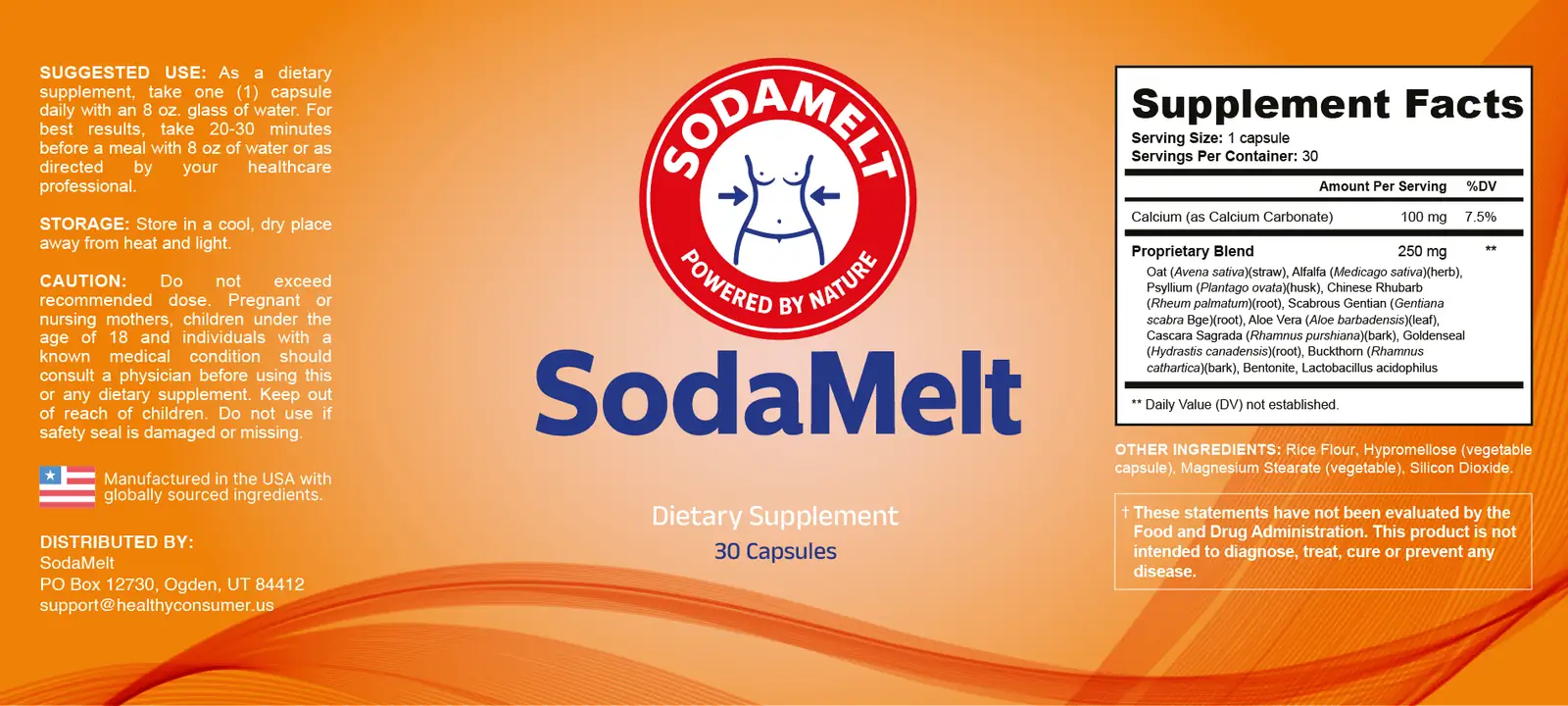
Now the exercise that is the point of this article. The SodaMelt panel prints eleven names in one 250 mg blend, plus 100 mg of calcium as calcium carbonate. The question is which of those names correspond to something the guideline reviewed.
| Panel row | Position | In the guideline's named agents? |
|---|---|---|
| Oat (straw) | 1 | Not by name |
| Alfalfa (herb) | 2 | No |
| Psyllium (husk) | 3 | Falls under the class "fibre", which the guideline reviewed |
| Chinese rhubarb (root) | 4 | No |
| Scabrous gentian (root) | 5 | No |
| Aloe vera (leaf) | 6 | No |
| Cascara sagrada (bark) | 7 | No |
| Goldenseal (root) | 8 | No |
| Buckthorn (bark) | 9 | No |
| Bentonite | 10 | No |
| Lactobacillus acidophilus | 11 | No |
| Calcium (as calcium carbonate) | Separate row, 100 mg | No |
Judged against the agents named in the guideline's abstract. Only the fibre class overlaps, through psyllium.
The result is stark. Of twelve names, one corresponds to a class the guideline reviewed, and it is the one whose research dose is furthest from anything a capsule can hold. The four stimulant plants on the panel, cascara, aloe, rhubarb and buckthorn, share a chemistry with senna. The guideline recommends senna itself, conditionally. It does not name any of the four.
That is not proof that those four do nothing. It means the guideline neither endorses nor rejects them, because they were not what it set out to review. A seller can say truthfully that the plants belong to the same chemical family as senna. A reader should notice that family resemblance is not the same as trial evidence, and that the trial evidence for constipation belongs to one specific plant and specific amounts.
The fibre row: a class with a dose
Psyllium is the honest overlap, so it deserves the detail. The most recent meta-analysis pooled 16 randomised trials with 1,251 people with chronic constipation. About two thirds of those given fibre responded, against about 41 percent given control treatment, and psyllium and pectin were the types with significant effects. The authors' summary of the optimal regimen is specific: doses above 10 g a day, and treatment durations of at least four weeks (the fibre meta-analysis). Flatulence was higher in the fibre groups.
An earlier systematic review of six trials reached a compatible conclusion for soluble fibre, with improvements in global symptoms, straining and stool consistency, and about one extra stool a week, while calling the evidence for insoluble fibre conflicting (the earlier fibre review).
Now the arithmetic. Ten grams is 10,000 mg. The entire SodaMelt blend is 250 mg, which is a fortieth. If the whole capsule were psyllium and nothing else, it would still be about 2.5 percent of the lowest dose the pooled analysis found to be effective. With ten other names sharing the figure, the psyllium is a small part of that small part. The article on why the psyllium dose is measured in grams works the same figure from the mechanism side.
The stimulant row: one plant, one dose
The stimulant family gets the same treatment. The best controlled evidence for a plant stimulant in chronic constipation is a randomised, double-blind, placebo-controlled trial of 90 patients, mean age 42, 93 percent of them women, who took senna at 1.0 g, magnesium oxide at 1.5 g, or placebo for 28 days. The response rate for overall improvement was 69.2 percent on senna, 68.3 percent on magnesium oxide and 11.7 percent on placebo, with no severe treatment-related adverse events (the senna versus magnesium oxide trial).
Three points come out of that. First, the plant stimulant worked, clearly, in that trial, so this is not a case of a class being useless. Second, the placebo response was 11.7 percent, so the comparison was fair and the effect was real. Third, the dose was a gram.
It is also worth looking at who those 90 people were. The mean duration of their symptoms was 9.9 years. These were long-standing chronic constipation patients, enrolled in a study, monitored for four weeks. That population is not the person with a slow week after travel, and it is not the buyer who has read a product page and wants something for general digestive comfort. The trial says what a gram of senna did for people with a decade of constipation. It says nothing about a milligram-scale share of a blend in someone with an occasional problem, and that is the reading the trial can bear.
1.0 g of senna was the tested dose. The entire SodaMelt blend, across all eleven names and all four stimulant plants together, weighs 0.25 g. Senna and the four plants here are not interchangeable milligram for milligram, so this is a comparison of scale, not of potency. It does show that no honest reading of the panel puts a trial-sized dose of any stimulant plant in one capsule.
Read the whole SodaMelt panel beside the guideline
Twelve names, one weight order, and only two amounts printed. The supplement facts page transcribes both rows and the four inactive ingredients.
One bottle $89 · six bottles $294 · 60-day money-back guarantee
Order SodaMelt On The Official WebsiteOne capsule a day · 30 per bottle · lot SOD-26/MY-2226
Reading a conditional recommendation properly
A word about how to use a guideline like this without over-reading it. A strong recommendation means the panel is confident that most patients would want the drug. A conditional one means the choice is more personal, and that reasonable people, with reasonable evidence in front of them, might choose differently. It does not mean the intervention fails.
That is the spirit in which fibre and senna appear. Both are reasonable options in the panel's view, and both come with a dose and a duration that the trials used. The guideline makes no comment on a product it did not review, and a reader who says a botanical capsule is backed by the guideline has stretched the document past what it says. Equally, a reader who says the guideline rules the capsule out has stretched it the other way. The document is silent on this bottle, and that silence is the finding.
What sits below the capsule on the shelf
A guideline about drugs does not cover food, so it cannot say what a kitchen can do. A 2024 systematic review did try. It pooled 23 studies with 1,714 participants on foods, drinks and diets in adults with chronic constipation: kiwifruit in seven of them, high-mineral water in four, prunes and rye bread in two each, plus single studies of mango, fig, cereal, oat bran, yoghurt and others. Fruit produced a higher stool frequency than psyllium, by about a third of a bowel movement a week, and kiwifruit specifically did so. Prunes did about as well as psyllium. High-mineral water produced a higher response than low-mineral water, with a risk ratio of 1.47 in 539 people (the review of foods, drinks and diets).
The authors are candid about the limits: they call the evidence on foods, drinks and diets scarce and say further trials are needed. It would be wrong to present kiwifruit as a proven replacement for anything. The point is narrower. The comparison group for a botanical capsule is not nothing. It includes items that cost a few dollars, have their own randomised evidence and come with no lot number.
It also explains the water in the label directions. The bottle's suggested use asks for an 8 oz glass of water with each capsule. That is worth doing whatever else is true, and the how to use page takes the clause apart.
Where a capsule like this could honestly fit
This is the part that is easy to get wrong in either direction. Nothing here says SodaMelt does not work, and nothing here says it does. The label makes no benefit claim, and the seller's wording about healthy digestion is the seller's, as the benefits page sets out.
What the guideline supports is a way of ranking the questions to ask of any capsule sold for this purpose:
- What is the active ingredient, by name? On this panel the only mechanism with a plausible reach at 250 mg is the stimulant family, and that is a family, not a trialled product.
- What amount did the trials use? Grams, for both fibre and senna.
- For how long? Four weeks in the senna trial and at least four weeks for the fibre effect. The article on how long a stimulant laxative is meant to be taken takes on the harder question of what long-running use looks like.
- What else has been tried? Fibre from food, fluid, and the cheaper items above.
A short course of a stimulant is a normal part of the shelf and a normal part of the guideline. The mismatch this article documents is not with the idea of a stimulant. It is with the gap between a trial dose and a blend total, which the guideline makes visible because it prints its doses.
What this article cannot tell you
It cannot tell you whether your own constipation is the chronic idiopathic kind. It cannot tell you whether a change in bowel habit needs a test. If constipation is new for you, keeps returning, or comes with anything that worries you, that belongs with a clinician before any capsule, and the label's own caution about a known medical condition points the same way.
It also cannot say what the seller's product does at the amounts it contains, because those amounts are not printed. That is the constraint every article on this blog works from, and the 250 mg divided eleven ways piece is the plainest statement of it.
What it can do is give a reader a benchmark that did not come from a seller: two societies, a systematic search, and a table of agents and verdicts. Held beside a twelve-name panel, that benchmark shows clearly which rows have been tested at which doses and which have not. That is worth more than a verdict, because it works for the next bottle too.
References
- Chang L, Chey WD, Imdad A, Almario CV, Bharucha AE, Diem S, et al. American Gastroenterological Association-American College of Gastroenterology Clinical Practice Guideline: Pharmacological Management of Chronic Idiopathic Constipation. Gastroenterology. 2023;164(7):1086-1106. PMID 37211380. https://pubmed.ncbi.nlm.nih.gov/37211380/
- van der Schoot A, Drysdale C, Whelan K, Dimidi E. The Effect of Fiber Supplementation on Chronic Constipation in Adults: An Updated Systematic Review and Meta-Analysis of Randomized Controlled Trials. Am J Clin Nutr. 2022;116(4):953-969. PMID 35816465. https://pubmed.ncbi.nlm.nih.gov/35816465/
- Suares NC, Ford AC. Systematic review: the effects of fibre in the management of chronic idiopathic constipation. Aliment Pharmacol Ther. 2011;33(8):895-901. PMID 21332763. https://pubmed.ncbi.nlm.nih.gov/21332763/
- Morishita D, Tomita T, Mori S, Kimura T, Oshima T, Fukui H, et al. Senna Versus Magnesium Oxide for the Treatment of Chronic Constipation: A Randomized, Placebo-Controlled Trial. Am J Gastroenterol. 2021;116(1):152-161. PMID 32969946. https://pubmed.ncbi.nlm.nih.gov/32969946/
- Van Der Schoot A, Katsirma Z, Whelan K, Dimidi E. Systematic review and meta-analysis: Foods, drinks and diets and their effect on chronic constipation in adults. Aliment Pharmacol Ther. 2024;59(2):157-174. PMID 37905980. https://pubmed.ncbi.nlm.nih.gov/37905980/